Discover how recycled agricultural netting combines resource efficiency with the technical demands of modern farming.
Introduction: The Future of Agricultural Packaging Is Changing
Agriculture depends on packaging materials that can withstand demanding working conditions.
From baling and transportation to outdoor storage, bale net wrap must deliver reliable strength, consistent performance and effective load containment.
At the same time, farmers, agricultural contractors and distributors are increasingly interested in reducing their environmental impact.
Plastic packaging is an important part of this discussion.
Traditionally, many agricultural net wrap products have been manufactured from virgin polymer materials. Today, advances in recycling, material processing and manufacturing technology are creating new opportunities for using recycled plastics in agricultural applications.
One promising solution is recycled bale net wrap.
But an important question remains:
Can bale net wrap made from recycled plastic provide the reliability farmers expect from conventional products?
The answer depends on material quality, manufacturing technology, product design and testing.
Let’s explore how recycled net wrap works, its potential advantages and what farmers should consider before making the switch.
1. What Is Recycled Bale Net Wrap?
Recycled bale net wrap is agricultural netting manufactured using plastic materials recovered through recycling processes.
Instead of relying exclusively on newly produced polymers, manufacturers incorporate recycled plastic into the production process.
The recycled content may come from different sources, but two categories are particularly important.
Post-Industrial Recycled Plastic (PIR)
Post-industrial recycled material comes from manufacturing processes.
Examples include production offcuts, rejected products and other recoverable plastic waste generated before a product reaches consumers.
Because the material often comes from relatively controlled production environments, its composition may be easier to manage.
Post-Consumer Recycled Plastic (PCR)
Post-consumer recycled material comes from products that have already completed their intended use and entered a waste collection or recycling system.
These materials are collected, sorted, processed and prepared for manufacturing new products.
Using PCR materials can help create demand for recovered plastics and reduce dependence on virgin raw materials.
However, the quality of recycled feedstock can vary depending on its origin, sorting accuracy and processing conditions.
Introducing RECONET
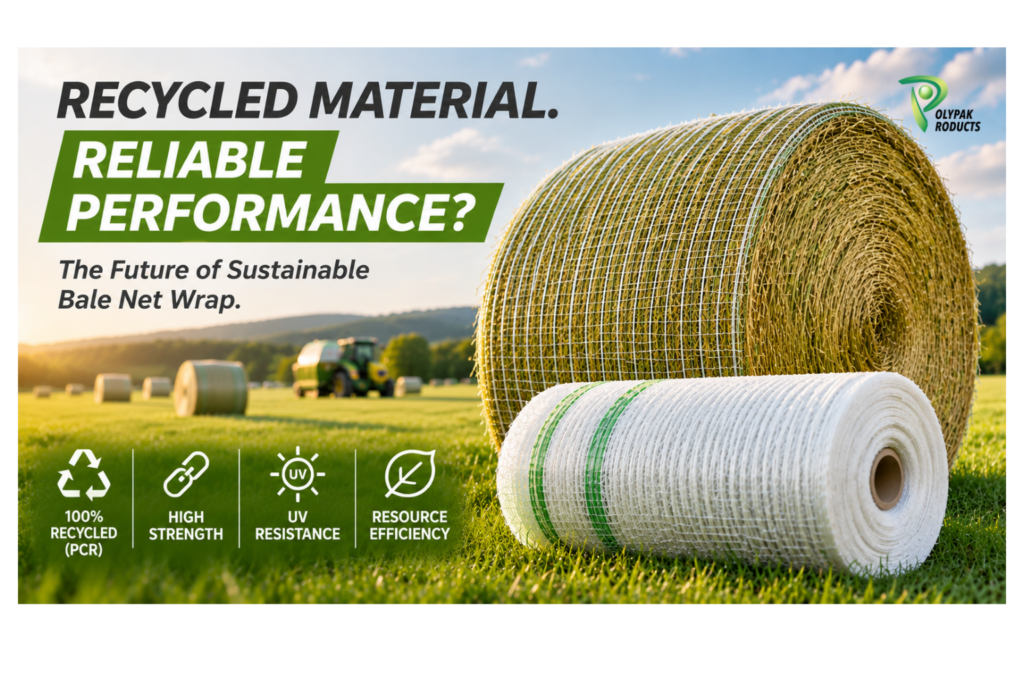
Polypak’s RECONET Recycled Bale Net Wrap is presented as a product manufactured from 100% post-consumer recycled material.
It represents an approach to agricultural packaging that incorporates recovered plastic into a new product designed for baling applications.
For farmers and distributors interested in recycled-content packaging, RECONET provides an opportunity to evaluate an alternative to conventional net wrap.
2. Why Is Recycled Agricultural Packaging Becoming More Important?
Sustainability is increasingly relevant throughout agricultural supply chains.
Farmers face growing pressure to use resources efficiently, while distributors and agricultural suppliers are exploring products that support their customers’ environmental objectives.
Packaging materials are one area where businesses can review their resource consumption.
Reducing dependence on virgin materials
Virgin plastics are generally produced from newly extracted fossil-based feedstocks.
Using recycled polymers can reduce the amount of virgin material required for manufacturing.
The actual environmental benefit depends on the recycling process, energy sources, transportation distances and product performance.
Supporting circular material flows
Recycling allows suitable plastic waste to become a resource for new manufacturing processes.
Instead of treating all used plastic as waste, recycling systems can recover material for further applications.
This supports the principles of a circular economy, where resources remain in productive use for longer.
Responding to customer expectations
Agricultural distributors increasingly serve customers who evaluate products according to both performance and environmental considerations.
Recycled-content packaging can become part of a broader purchasing strategy that includes material efficiency, waste reduction and responsible sourcing.
Improving resource awareness
The transition toward more sustainable packaging also encourages businesses to measure how much material they use.
Reducing unnecessary wrapping, selecting suitable roll specifications and minimizing damaged bales can all contribute to more efficient operations.
The key principle: Sustainable packaging should be evaluated through both environmental performance and practical functionality.
3. Can Recycled Bale Net Wrap Be as Strong as Conventional Net Wrap?
Mechanical strength is one of the most important characteristics of agricultural netting.
During baling, the net must withstand tension as it is applied around compressed forage.
After wrapping, it must help maintain the bale’s shape during ejection, handling and transportation.
The ability to perform these tasks depends on several technical properties.
Tensile strength
Tensile strength describes how much force a material can withstand before breaking under specified test conditions.
For bale net wrap, adequate strength is essential to secure tightly compressed hay and straw.
Elongation
Elongation determines how much the net can stretch under tension.
Appropriate elongation helps the material adapt to the bale surface while maintaining secure containment.
Knot and strand consistency
Bale net is a knitted structure.
Uniform strands and consistent construction help distribute forces across the net during application.
Manufacturing quality
Extrusion, knitting and process control influence the final performance of the product.
Recycled polymers can have different processing characteristics from virgin materials.
For this reason, manufacturers must carefully manage material preparation, formulation and production parameters.
Is equal performance possible?
Recycled-content net wrap can potentially achieve performance comparable to conventional netting when it is appropriately engineered and validated.
However, equal performance should not be assumed simply because two products look similar.
The most reliable comparison involves testing:
- Tensile strength
- Elongation
- Net width consistency
- Resistance to breakage
- Performance during baling
- Bale stability during handling
Farmers should request technical specifications and, where practical, evaluate the product under real operating conditions.
The key advantage: Recycled material does not automatically mean poor performance, but verified product quality remains essential.
4. UV Resistance: An Essential Requirement for Outdoor Bale Storage
Many agricultural bales are stored outdoors for extended periods.
During storage, bale net wrap is exposed to sunlight, changing temperatures, moisture and mechanical stress.
Ultraviolet radiation can gradually affect polymer properties, potentially reducing flexibility and mechanical strength.
This makes UV stabilization an important consideration for both conventional and recycled netting.
Why recycled materials require careful evaluation
Recycled plastic may have experienced previous environmental exposure or processing cycles.
Depending on its history, the polymer can have different degradation characteristics from virgin material.
Manufacturers may address these challenges through material selection, formulation and stabilization technologies.
However, UV resistance must be verified for the finished product.
What farmers should check
Before purchasing recycled bale net wrap, ask the supplier about:
- Declared UV stabilization
- Recommended outdoor storage duration
- Test conditions
- Suitable storage environments
- Product-specific limitations
Farmers should not assume that the UV rating of a manufacturer’s conventional net wrap also applies to its recycled-content range.
Practical recommendation: Select a recycled net with verified UV performance appropriate for the expected storage conditions.
5. Bale Stability and Edge-to-Edge Coverage
Good bale net wrap must do more than resist breaking.
It should distribute evenly across the bale and help secure the forage from edge to edge.
Poor coverage can leave loose material at the sides of the bale, increasing the risk of forage loss during handling.
Why coverage matters
Consistent net distribution contributes to:
- Better bale shape retention
- Reduced loose forage at the edges
- More reliable handling
- Efficient transportation
- Neater bale presentation
The performance of recycled net wrap in these areas depends on its construction, elasticity and compatibility with the baler.
Compatibility with baling equipment
Different balers have specific requirements for net width, roll diameter, feeding characteristics and tension.
Before switching to recycled net wrap, operators should verify that the product is suitable for their machinery.
A short field trial can help identify any adjustments needed for reliable operation.
Practical recommendation: Evaluate edge coverage and bale stability during actual baling, not only through laboratory specifications.
6. Recycled vs Virgin Bale Net Wrap: Key Differences
Both conventional and recycled bale net wrap can serve important roles in agricultural packaging.
The most appropriate choice depends on technical requirements, supplier specifications and operational priorities.
| Comparison Factor | Virgin Bale Net Wrap | Recycled Bale Net Wrap |
|---|---|---|
| Raw material | Newly produced polymer | Recovered and reprocessed polymer |
| Virgin material demand | Higher | Potentially reduced |
| Tensile strength | Depends on formulation and production | Depends on formulation and production |
| Elongation | Product-specific | Product-specific |
| UV resistance | Requires suitable stabilization | Requires suitable stabilization and verification |
| Bale coverage | Depends on net design | Depends on net design |
| Baler compatibility | Must be verified | Must be verified |
| Environmental impact | Depends on the full life cycle | Depends on recycled content and full life cycle |
| Price | Varies by product and market | Varies by product and market |
| Quality consistency | Depends on manufacturing controls | Depends on feedstock and manufacturing controls |
The table demonstrates that recycled content alone does not determine product performance.
A properly manufactured recycled net may be suitable for demanding agricultural applications.
However, purchasing decisions should always be supported by reliable technical information.
7. Does Recycled Bale Net Wrap Actually Reduce Environmental Impact?
Using recycled material can offer environmental benefits, but these benefits should be evaluated carefully.
The percentage of recycled content is an important indicator, yet it does not describe the entire environmental impact of a product.
A complete assessment considers multiple stages of the product life cycle.
Raw material production
Using recycled polymers can reduce the demand for newly produced plastic.
Recycling and processing
Collection, sorting, washing, reprocessing and transportation require energy and resources.
Manufacturing
The production process influences material efficiency, energy consumption and waste generation.
Product use
If a recycled net requires significantly more material to secure each bale, this can affect its overall resource efficiency.
Conversely, a recycled net that performs reliably with suitable material consumption may support efficient packaging.
End-of-life management
Used agricultural net wrap can be difficult to recycle when contaminated with soil, forage residues or other materials.
Collection infrastructure and local recycling capabilities also vary.
Farmers should therefore check available agricultural plastic collection systems and follow local waste management requirements.
Why life-cycle thinking matters
A credible sustainability assessment should consider the entire product journey rather than focusing on one environmental attribute.
Claims such as lower carbon emissions or reduced environmental footprint should be supported by product-specific evidence.
The key principle: Recycled content is an important sustainability characteristic, but overall environmental performance depends on the full product life cycle.
8. How to Evaluate the Real Cost of Recycled Net Wrap
For farmers, sustainable packaging must also make economic sense.
The price of a roll is only one component of the total packaging cost.
A more useful measurement is the cost per successfully wrapped bale.
Basic calculation
Net wrap cost per bale = Roll purchase price ÷ Number of acceptable bales produced
For example, consider two hypothetical products.
| Parameter | Conventional Net | Recycled Net |
|---|---|---|
| Roll price | €220 | €210 |
| Acceptable bales per roll | 200 | 195 |
| Net cost per bale | €1.10 | €1.08 |
These prices and production figures are illustrative and do not represent actual Polypak product specifications or quotations.
In this example, recycled net offers a slightly lower material cost per bale.
However, the calculation should also include operational factors such as:
- Net breakages
- Wrapping interruptions
- Additional layers required
- Bale damage
- Labour costs
- Machine downtime
A recycled net should not be considered more economical solely because its roll price is lower.
Similarly, a higher purchase price may be justified when a product offers reliable performance and reduced operational losses.
The best choice is the one that provides the appropriate balance of cost, functionality and environmental objectives.
9. What Should Farmers Ask Before Buying Recycled Bale Net Wrap?
Switching to recycled agricultural packaging should be a well-informed decision.
Before purchasing, ask your supplier the following questions.
1. What percentage of recycled material does the product contain?
Check whether the product uses post-consumer or post-industrial recycled content.
2. Are the mechanical properties documented?
Request relevant tensile strength and elongation specifications.
3. What UV protection is provided?
Confirm the declared outdoor exposure performance.
4. Is the net compatible with my baler?
Verify roll dimensions, width and feeding requirements.
5. How many wraps are recommended?
Determine whether the product can secure your typical hay or straw bales under normal operating conditions.
6. How is product quality controlled?
Ask about manufacturing checks, testing procedures and consistency between production batches.
7. Can I test the product before making a large purchase?
A practical field trial can help verify performance under real farming conditions.
These questions allow buyers to evaluate recycled net wrap based on measurable characteristics rather than marketing claims.
10. RECONET by Polypak: A Recycled-Content Approach to Agricultural Packaging
Polypak offers a range of agricultural net wrap solutions for different farming requirements.
Among these products is RECONET — Recycled Bale Net Wrap, presented as being manufactured from 100% post-consumer recycled material.
RECONET reflects the growing interest in agricultural packaging that uses recovered plastic resources.
For farmers, contractors and agricultural distributors, it provides an option worth considering when evaluating recycled-content packaging solutions.
As with any bale net wrap, the appropriate product specification should be selected according to:
- Crop type
- Bale dimensions
- Baler compatibility
- Required wrapping strength
- Handling conditions
- Storage duration
Buyers should request the current RECONET technical data sheet to confirm mechanical properties, available dimensions, UV performance and recommended applications.
Why choose Polypak?
Polypak has extensive experience in agricultural net wrap manufacturing and offers different product solutions for professional farming operations.
The company emphasizes quality control, manufacturing expertise and a broad agricultural packaging portfolio.
By introducing recycled-content products alongside conventional net wrap solutions, Polypak gives customers additional options for meeting their packaging requirements.
11. The Future of Sustainable Bale Packaging
The agricultural packaging industry continues to evolve.
Manufacturers are exploring ways to improve resource efficiency while maintaining the mechanical performance required by modern farming equipment.
Several developments are particularly relevant.
Improved recycling technologies
Better sorting and processing can help increase the consistency of recovered polymer materials.
More advanced material formulations
Research into polymer blends, additives and processing technologies may expand the range of applications suitable for recycled plastics.
Greater transparency
Customers increasingly expect clear information about recycled content, material origin and product performance.
More efficient packaging
Reducing unnecessary material consumption remains an important opportunity for both conventional and recycled packaging products.
Stronger collection systems
Improved agricultural plastic collection and recycling infrastructure could help recover more material after use.
These developments may support wider adoption of recycled-content agricultural packaging over time.
Conclusion: Sustainability and Performance Should Work Together
Recycled bale net wrap represents an important opportunity for agricultural businesses seeking to use resources more responsibly.
By incorporating recovered plastic into new products, manufacturers can reduce reliance on virgin materials and support circular material flows.
However, recycled content alone does not guarantee packaging quality or lower environmental impact.
Mechanical strength, UV resistance, bale coverage, equipment compatibility and operational efficiency remain essential.
For farmers, the goal should be to choose packaging that meets both technical requirements and sustainability objectives.
The future of agricultural packaging is not simply about using recycled materials. It is about combining responsible resource use with reliable performance.
Explore RECONET Recycled Bale Net Wrap
Interested in agricultural net wrap manufactured from post-consumer recycled material?
Discover RECONET by Polypak and contact our team to discuss product availability, technical specifications and suitable applications for your farming operation.