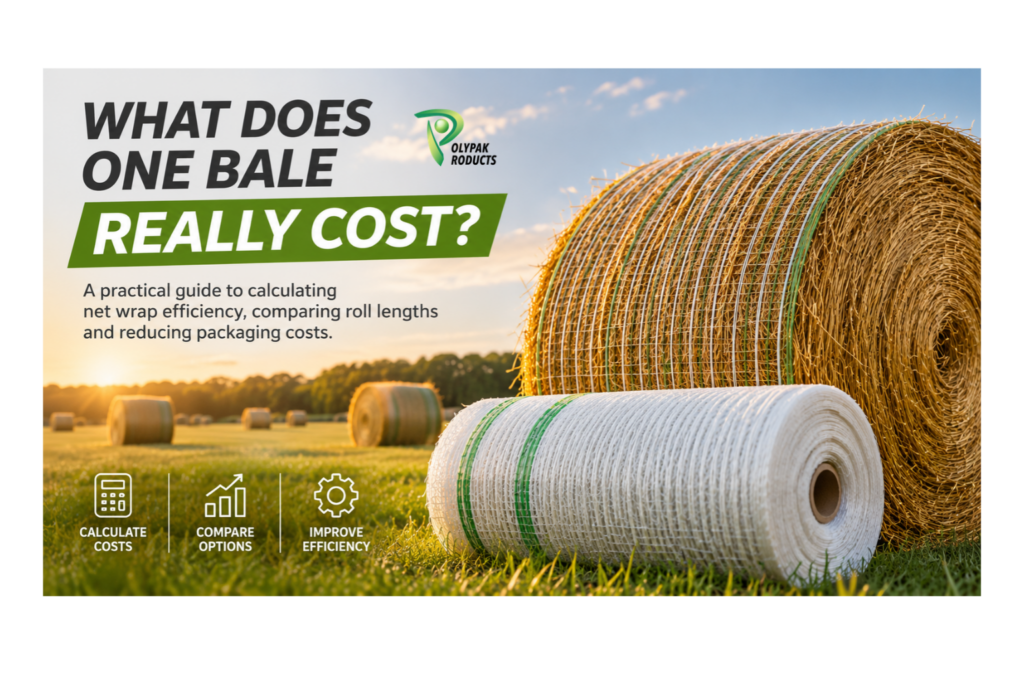
Why the cheapest roll of bale net wrap is not always the most economical choice
In modern agriculture, efficiency is measured not only by how quickly crops are harvested but also by how effectively resources are used. Every minute of machinery operation, every metre of packaging material and every bale produced contributes to the final cost of forage production.
For farmers and agricultural contractors, bale net wrap is an essential consumable. However, many purchasing decisions are still based primarily on the price of a roll.
But is the cheapest roll really the most cost-effective option?
Not necessarily.
The true cost of bale net wrap depends on several factors, including roll length, bale diameter, the number of wraps applied, material quality and operational efficiency.
Understanding these variables allows farmers to make better purchasing decisions, reduce unnecessary expenses and improve productivity throughout the baling season.
1. Why Cost per Bale Matters More Than Cost per Roll
When comparing different bale net wrap products, the purchase price is usually the first number farmers consider.
However, two rolls with different prices may deliver very different results.
For example, a less expensive roll may contain fewer metres of netting or require more layers to secure each bale.
A higher-priced roll may offer a longer usable length, more consistent performance and fewer interruptions during baling.
The most useful metric is therefore not the price per roll, but the cost of net wrap per successfully completed bale.
This approach helps farmers evaluate the actual economic performance of their packaging materials.
A complete assessment should consider:
- Roll purchase price
- Usable net length
- Number of bales produced per roll
- Number of wraps required per bale
- Net breakages and material waste
- Time spent changing rolls
- Bale stability during handling and storage
By considering these factors together, farmers can identify which product offers the best overall value.
2. How Much Net Wrap Is Needed for One Round Bale?
The amount of net wrap required depends primarily on the bale’s circumference and the number of layers applied.
A basic calculation uses the following formula:
Net wrap length per bale = π × Bale diameter × Number of wraps
Where:
- π = 3.1416
- Bale diameter = diameter of the finished round bale in metres
- Number of wraps = complete layers of net applied around the bale
Practical example
Consider a farm producing round hay bales with the following characteristics:
- Bale diameter: 1.5 m
- Number of wraps: 3.5
- Roll length: 3,000 m
First, calculate the circumference of the bale:
1.5 × 3.1416 = 4.71 m
Next, calculate the theoretical net length required:
4.71 × 3.5 = 16.49 m per bale
Finally, divide the roll length by the calculated consumption:
3,000 ÷ 16.49 ≈ 182 bales
The theoretical result is approximately 181 complete bales per 3,000 m roll.
This calculation provides a useful starting point for planning material consumption.
However, it represents the geometric length applied to the bale surface, not necessarily the exact length drawn from the roll. Net tension, material elongation, feeding mechanisms, cutting allowances and operational waste can affect actual consumption.
For accurate budgeting, farmers should compare the theoretical result with the number of acceptable bales produced during normal field operation.
3. Comparing Different Net Wrap Roll Lengths
Bale net wrap is available in different roll lengths to meet the requirements of various balers and farming operations.
For example, the Polypak product range includes options such as 3,000 m, 3,600 m and 4,200 m rolls.
Longer rolls can reduce the frequency of roll changes, particularly during intensive harvesting periods.
Example: Theoretical bale output by roll length
Assuming a bale diameter of 1.5 m and 3.5 wraps per bale:
| Roll Length | Theoretical Complete Bales |
|---|---|
| 3,000 m | 181 |
| 3,600 m | 218 |
| 4,200 m | 254 |
These figures are geometric estimates, rounded down to complete bales. Actual results depend on the baler, net properties and operating conditions.
A 4,200 m roll provides approximately 40% more nominal material than a 3,000 m roll.
This additional length can be particularly valuable for contractors and large farms producing thousands of bales each season.
Nevertheless, longer rolls must be compatible with the baler’s roll compartment, maximum permitted roll weight and feeding system.
4. Calculating the Real Cost per Bale
Once the actual number of bales produced per roll is known, calculating material cost becomes straightforward.
Cost per bale = Roll purchase price ÷ Number of acceptable bales produced
Consider the following hypothetical example.
| Parameter | Option A | Option B | Option C |
|---|---|---|---|
| Roll length | 3,000 m | 3,600 m | 4,200 m |
| Example roll price | €180 | €210 | €240 |
| Theoretical complete bales | 181 | 218 | 254 |
| Approx. net cost per bale | €0.99 | €0.96 | €0.94 |
Prices are illustrative and do not represent actual Polypak quotations. The calculations use theoretical geometric bale output.
Although Option C has the highest purchase price, it offers the lowest estimated material cost per bale in this example.
The difference may appear small, but it becomes more meaningful when multiplied by thousands of bales.
For a farm producing 5,000 bales annually, a saving of €0.05 per bale represents approximately €250 in net wrap material costs alone.
Additional savings may come from reduced downtime and more reliable operation.
The key lesson is simple:
Compare packaging costs per finished bale, not only per purchased roll.
5. How the Number of Wraps Affects Costs
The number of net layers applied to each bale has a direct impact on material consumption.
More wraps require more netting, increasing the cost per bale.
However, applying too few layers can compromise bale stability and increase the risk of damage during handling.
The correct number of wraps depends on:
- Crop type and stem characteristics
- Bale diameter and density
- Net wrap strength
- Storage conditions
- Transport distance
- Frequency of bale handling
For example, dry straw can place different mechanical demands on net wrap than grass silage or hay.
Large, densely packed bales may also require additional layers to maintain their shape.
The objective should never be to minimize the number of wraps at any cost.
Instead, farmers should identify the lowest number of wraps that reliably provides the required bale stability, following the baler and net wrap manufacturers’ recommendations.
The cost of one additional wrap
For a bale measuring 1.5 m in diameter, one additional complete wrap represents approximately 4.71 m of extra net coverage.
Across 5,000 bales, that equals approximately 23,562 m of additional geometric coverage.
This illustrates why correct machine settings are so important.
Even a small change in the number of wraps can significantly affect seasonal material requirements.
6. The Hidden Costs of Low-Quality Net Wrap
The financial impact of bale net wrap extends beyond material consumption.
Poor-quality netting can create operational problems that are not immediately visible in the purchase price.
Frequent net breakages
Net breakages interrupt the baling process and may require operators to stop, inspect the feeding system or rewrap damaged bales.
Each interruption reduces productivity.
Inconsistent net distribution
Uneven spreading across the bale width can leave edges insufficiently secured.
This may contribute to forage losses, deformation and difficulties during transportation.
Unreliable tension
Netting that behaves inconsistently under tension can affect bale stability and increase the likelihood of operational problems.
Additional labour
Repeated stops, roll changes and damaged bales create additional work for machine operators.
During short harvesting windows, lost working time can be particularly costly.
For these reasons, high-quality net wrap should be evaluated as a productivity investment rather than simply a consumable expense.
7. Why Longer Rolls Can Improve Baling Efficiency
One of the most practical advantages of longer net wrap rolls is the reduction in roll changes.
Every roll replacement requires the baler to stop.
Depending on the equipment and operating conditions, the process may include removing the empty core, installing a new roll, threading the net and checking the feeding mechanism.
Consider a farm producing 5,000 round bales.
Using the theoretical output from our earlier example:
| Roll Length | Approx. Rolls Required |
|---|---|
| 3,000 m | 28 |
| 3,600 m | 23 |
| 4,200 m | 20 |
These estimates demonstrate how longer rolls can reduce the number of replacements required during the season.
Fewer roll changes may result in:
- Less downtime
- Better workflow continuity
- Reduced operator interruptions
- More productive use of harvesting windows
For agricultural contractors, these operational advantages can be particularly important because machine productivity directly affects profitability.
8. Choosing the Right Net Wrap Width
Roll length is not the only important dimension.
Net wrap width must also be compatible with the baler and the intended bale size.
Common product widths include 123 cm, 125 cm and 130 cm, depending on the net wrap specification.
The correct width helps ensure appropriate coverage across the bale surface.
Insufficient edge coverage can lead to loose forage, reduced bale stability and additional material losses.
However, wider netting is not automatically better.
The selected product must be suitable for the machine’s feeding and spreading system.
Before purchasing, always verify the baler’s technical requirements and the manufacturer’s recommended net wrap dimensions.
9. Net Wrap Quality and Forage Preservation
The primary purpose of bale net wrap is to secure the bale and maintain its structure.
Reliable wrapping can help reduce forage losses during handling, transportation and storage.
This is particularly important for valuable forage crops, where even relatively small losses can affect overall profitability.
However, net wrap should not be confused with airtight silage stretch film.
Net wrap is a breathable securing material. It does not create a waterproof or oxygen-tight barrier.
For outdoor storage, farmers should combine appropriate net wrap with good storage practices, including proper drainage, suitable bale placement and additional weather protection where necessary.
The economic value of net wrap therefore comes from its contribution to a complete forage management system.
10. Five Practical Ways to Reduce Net Wrap Costs
Farmers looking to improve efficiency should focus on the entire baling process rather than simply purchasing cheaper materials.
1. Monitor actual consumption
Record how many acceptable bales are produced from each roll. Compare results across different net wrap products and operating conditions.
2. Optimize the number of wraps
Follow manufacturer recommendations and avoid unnecessary layers without compromising bale integrity.
3. Select the correct roll dimensions
Choose the appropriate width and roll length for the baler and expected production volume.
4. Maintain the baler
Regularly inspect the feeding system, rollers, cutting mechanism and tension settings to prevent avoidable waste.
5. Evaluate total operating costs
Include downtime, labour, damaged bales and material consumption when comparing products.
These simple practices can improve cost transparency and support more informed purchasing decisions.
11. How to Choose the Most Economical Net Wrap for Your Farm
There is no single net wrap specification that is ideal for every agricultural operation.
A small livestock farm producing a few hundred bales annually may have different priorities from a contractor producing tens of thousands.
When selecting net wrap, consider the following questions:
- How many bales do you produce each season?
- What is the typical bale diameter?
- Which crops are you baling?
- How many wraps are required?
- How frequently are the bales handled?
- Are the bales stored indoors or outdoors?
- Which roll dimensions are compatible with your baler?
By answering these questions, farmers can identify the solution that offers the best balance between material cost, operational reliability and bale protection.
Conclusion: Better Calculations Lead to Better Farming Decisions
The real cost of bale net wrap cannot be determined by looking at the roll price alone.
Roll length, net consumption, wrapping settings, machine compatibility and product quality all influence the final cost per bale.
For professional farming operations, even small improvements in material efficiency can generate meaningful savings across an entire harvesting season.
Choosing the right net wrap means balancing three essential priorities:
Cost efficiency. Operational productivity. Reliable bale protection.
When these factors are considered together, bale net wrap becomes more than a packaging material — it becomes an important part of efficient forage production.
Find the Right Bale Net Wrap for Your Operation
At Polypak, we understand that every agricultural operation has different requirements.
Whether you are looking for reliable net wrap performance, suitable roll dimensions or greater efficiency during baling, choosing the correct product is essential.
Explore our range of bale net wrap solutions and find the right option for your equipment and working conditions.