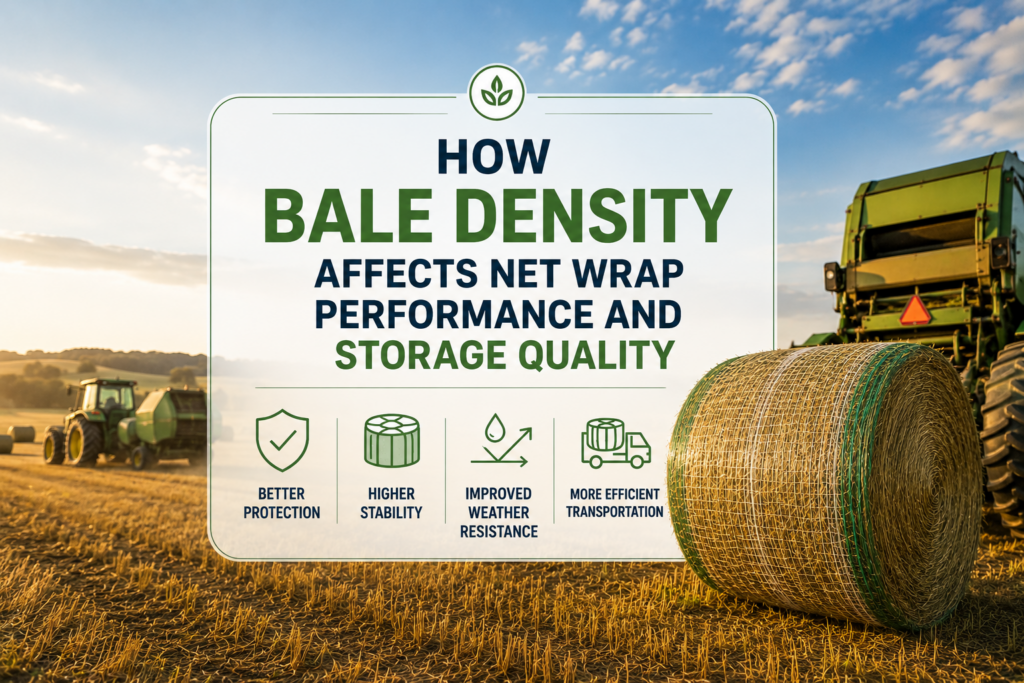
Producing high-quality round bales involves much more than choosing the right crop or baler settings. One of the most important factors influencing storage success, transportation safety, and forage preservation is bale density.
A properly compressed bale maintains its shape, sheds water more effectively, resists handling damage, and allows the bale net wrap to perform as intended. In contrast, poorly formed bales can lead to significant dry matter losses, higher transport costs, and unnecessary downtime.
In this guide, we’ll explain why bale density matters, how it affects net wrap performance, and what farmers can do to maximize efficiency throughout the harvesting season.
What Is Bale Density?
Bale density refers to the amount of crop material compressed into a specific bale volume.
Simply put:
- High-density bale = more forage packed into the same size bale.
- Low-density bale = less forage, more air pockets, and reduced stability.
Modern round balers are capable of producing extremely dense bales, but achieving consistent density depends on several factors, including:
- Crop moisture
- Crop type
- Windrow size
- Tractor speed
- Baler settings
- Net wrap quality
The objective is to create a bale that remains stable from the moment it leaves the baler until the feed is finally used.
Why Bale Density Is So Important
Dense bales provide several significant advantages.
Better Shape Retention
A dense bale maintains its cylindrical shape much better during storage.
Loose bales gradually expand after leaving the baler, placing additional stress on the net wrap. Excessive expansion may weaken the wrap or allow the bale to lose its original form.
A stable bale is easier to stack, transport, and protect from weather.
Improved Weather Resistance
Rain is one of the biggest threats to stored forage.
Dense bales have fewer air pockets and a smoother outer surface, allowing water to run off instead of penetrating deep into the forage.
Combined with premium bale net wrap, high-density bales help minimize moisture penetration and reduce spoilage.
Higher Transport Efficiency
Transportation costs continue to increase every year.
When bales are denser, more dry matter is transported in every load.
Benefits include:
- Fewer trips
- Lower fuel consumption
- Reduced labor
- Higher transport efficiency
- Better trailer utilization
For commercial farms and contractors, these savings quickly become significant.
How Bale Density Affects Bale Net Wrap Performance
The performance of any bale net wrap depends greatly on the quality of the bale underneath it.
Proper Compression Creates Uniform Tension
When a bale is evenly compressed, the net wrap stretches uniformly around the entire circumference.
This creates:
- Better edge coverage
- Consistent tension
- Reduced movement during transport
- Improved appearance
Uniform tension also minimizes the risk of wrinkles or loose sections.
Loose Bales Increase Stress on the Net
Low-density bales continue expanding after wrapping.
As the crop pushes outward, additional pressure is applied to the net wrap.
This may result in:
- Net stretching
- Edge separation
- Reduced stability
- Faster deterioration during storage
The better the bale structure, the more effectively the net wrap can perform.
Dense Bales Require Strong Net Wrap
Higher bale density increases internal pressure.
For this reason, premium net wrap with high tensile strength becomes even more important.
Quality products are engineered to withstand the pressure generated by tightly compressed forage while maintaining full coverage throughout storage and transportation.
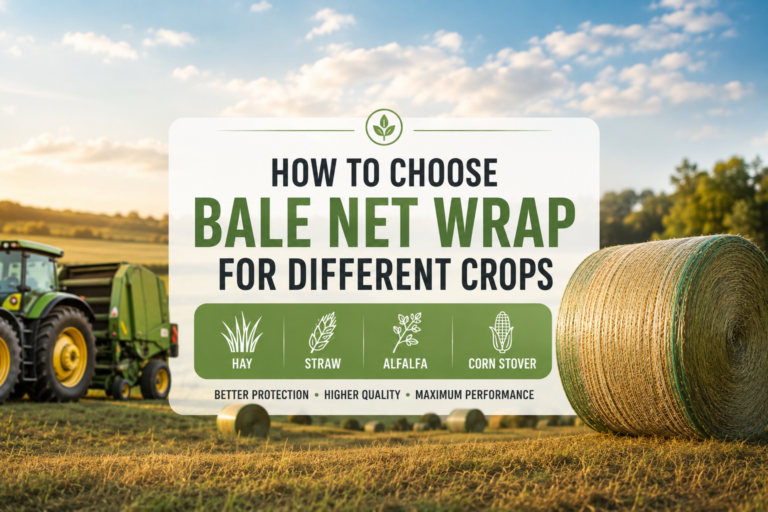
Crop Type and Bale Density
Every crop behaves differently inside the baler.
Hay
Hay compresses well and typically produces stable bales.
Proper density improves weather resistance and reduces spoilage during outdoor storage.
Straw
Straw is lighter and contains more rigid stems.
Producing sufficiently dense straw bales requires careful baler adjustment.
Higher density also minimizes bale movement during transport.
Alfalfa
Alfalfa contains fragile leaves rich in nutrients.
Loose bales allow excessive internal movement, causing valuable leaves to break off during handling.
Higher density helps preserve feed quality.
Corn Stover
Corn residue is coarse and bulky.
Dense bales improve stability while reducing deformation during stacking and transportation.
Storage Benefits of High-Density Bales
Storage losses can represent a major hidden cost.
High-density bales help reduce these losses by improving:
- Shape stability
- Moisture resistance
- Stackability
- Airflow management
- Handling durability
Combined with quality net wrap, they significantly improve long-term forage preservation.
The Relationship Between Bale Density and Dry Matter Loss
Every percentage of dry matter lost represents money left in the field.
Research consistently shows that poor bale formation contributes to:
- Increased spoilage
- Mold development
- Nutrient loss
- Lower feed value
Dense bales wrapped with high-quality net provide one of the most effective methods for reducing these losses.
Common Causes of Low Bale Density
Several factors may prevent proper compression.
Incorrect Moisture
Crop that is too wet or too dry compresses poorly.
Uneven Windrows
Inconsistent crop feeding causes irregular bale formation.
Incorrect Baler Settings
Modern balers allow operators to adjust pressure according to crop type.
Improper settings reduce final density.
Worn Equipment
Rollers, belts, bearings, and hydraulic systems all influence bale formation.
Regular maintenance is essential.
Low-Quality Net Wrap
Although net wrap does not create density, poor-quality products may fail to hold the bale securely after wrapping.
Choosing the Right Bale Net Wrap for Dense Bales
When producing high-density bales, look for net wrap offering:
- High tensile strength
- Excellent edge-to-edge coverage
- Uniform roll quality
- Reliable UV stabilization
- Smooth feeding through the baler
- Consistent stretching characteristics
- Roll end warning indicator
Premium products reduce interruptions and help maintain bale integrity throughout storage.
Best Practices for Maximizing Bale Quality
To achieve consistently dense, stable bales:
- Harvest at the correct moisture level.
- Maintain uniform windrows.
- Adjust baler density according to crop conditions.
- Replace worn baler components when necessary.
- Use premium bale net wrap.
- Store bales on well-drained surfaces.
- Protect bales from standing water.
- Handle bales carefully during transport.
Small improvements throughout the harvesting process can produce substantial savings over an entire season.
Why Quality Matters More Than Price
Many purchasing decisions focus solely on the price of the net wrap.
However, the net itself represents only a small percentage of the total harvesting cost.
If a better product reduces forage losses, minimizes downtime, and improves transportation efficiency, it often provides a much higher return on investment than the initial purchase price suggests.
For professional farming operations, reliability is usually far more valuable than the lowest price.
Conclusion
Bale density is one of the most influential factors affecting forage quality, transportation efficiency, and storage performance.
Dense, well-formed bales allow bale net wrap to perform at its highest level, providing better protection against weather, easier handling, and lower dry matter losses.
By combining proper baler settings with premium bale net wrap, farmers can improve harvesting efficiency while preserving more of the valuable crop they worked hard to produce.
Frequently Asked Questions
Why is bale density important?
Higher bale density improves shape retention, weather resistance, transportation efficiency, and forage preservation.
Can low bale density damage net wrap?
Yes. Loose bales continue expanding after wrapping, placing additional stress on the net and reducing overall stability.
Does denser always mean better?
Within the limits recommended by the baler manufacturer, higher density generally improves storage and handling. However, excessive compression beyond equipment specifications should be avoided.
What type of net wrap is best for dense bales?
Premium net wrap with high tensile strength, consistent stretching, reliable UV stabilization, and full edge-to-edge coverage delivers the best results for high-density round bales.
Looking for bale net wrap that performs under demanding harvesting conditions?
Polypak manufactures premium bale net wrap engineered for excellent tensile strength, consistent performance, and reliable protection across a wide range of crops and bale densities. Contact our team to learn more about our solutions for professional farming operations.