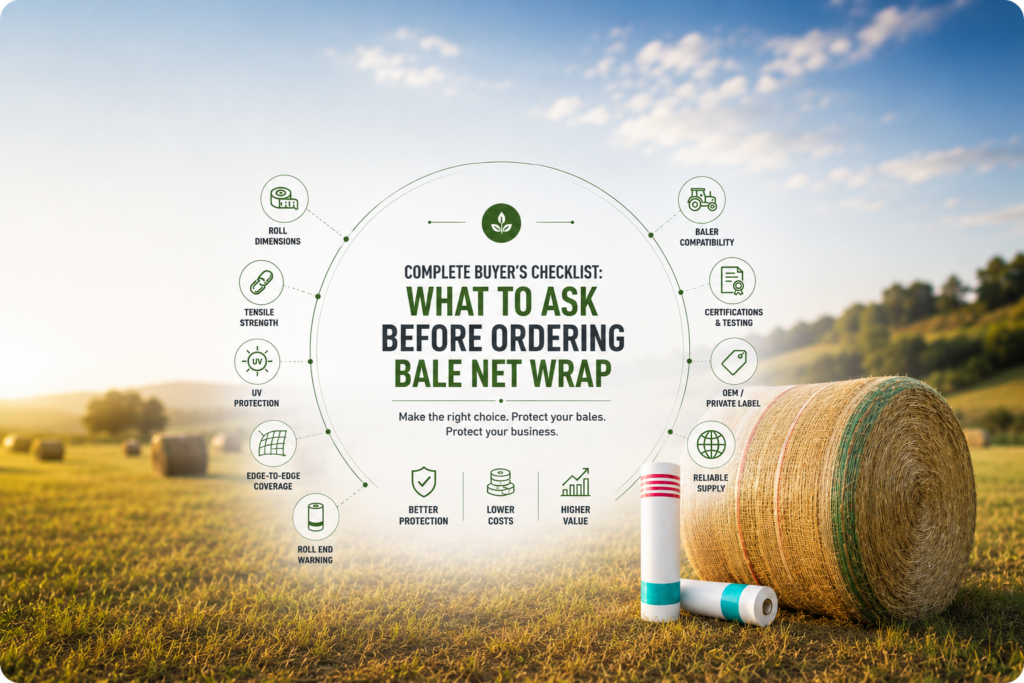
Purchasing bale net wrap may seem like a straightforward decision, but selecting the right supplier and product can have a significant impact on harvesting efficiency, forage quality, transportation costs, and overall profitability.
Many buyers compare only the price per roll. However, experienced distributors and professional farmers understand that the true cost of bale net wrap extends far beyond its purchase price.
Poor-quality products can result in machine downtime, damaged bales, increased crop losses, customer complaints, and higher operating costs.
Whether you’re a farmer, agricultural distributor, importer, or OEM brand owner, this checklist will help you make a confident purchasing decision.
1. Is the Net Wrap Compatible with Your Baler?
Compatibility should always be your first consideration.
Although most premium bale net wraps are designed to work with major baler manufacturers, not every product performs equally well across different machines.
Before placing an order, verify compatibility with brands such as:
- John Deere
- New Holland
- Claas
- Krone
- Massey Ferguson
- Case IH
- Kuhn
- Fendt
- McHale
- Kubota
Reliable suppliers should be able to confirm compatibility with your specific baler model.
2. What Are the Roll Dimensions?
Roll size directly affects productivity.
Important specifications include:
- Roll width
- Roll length
- Core diameter
- Roll weight
Using the correct dimensions minimizes machine adjustments and reduces downtime during harvesting.
3. Does the Net Provide Full Edge-to-Edge Coverage?
One of the most important quality indicators is edge coverage.
Premium bale net wrap should fully cover the shoulders of the bale.
Benefits include:
- Better weather protection
- Improved bale shape
- Reduced crop losses
- Easier transportation
- Greater stack stability
Poor edge coverage exposes forage to rain and increases spoilage.
4. What Is the Tensile Strength?
Tensile strength determines how much force the net wrap can withstand before breaking.
Higher tensile strength provides:
- Better bale compression
- Greater transport security
- Reduced tearing
- More reliable wrapping
This becomes especially important when working with:
- High-density bales
- Straw
- Corn stover
- Long-distance transportation
5. Is the Product UV Stabilized?
Many round bales remain outdoors for several months.
Without adequate UV protection, polypropylene fibers gradually weaken under sunlight.
High-quality UV stabilization helps maintain net performance throughout the storage season.
Ask your supplier about:
- UV additives
- Outdoor storage recommendations
- Climate suitability
6. Is Roll Quality Consistent?
Consistency is often overlooked.
Every roll should unwind smoothly without:
- Tangling
- Uneven stretching
- Broken edges
- Feeding problems
Consistent production quality reduces machine stoppages and improves harvesting efficiency.
7. Does the Roll Include an End Warning Indicator?
Roll-end warning stripes help operators prepare for roll replacement before the net is completely finished.
Advantages include:
- Less downtime
- Better harvest planning
- Reduced machine interruptions
- Improved productivity
While simple, this feature can save valuable time during busy harvest periods.
8. How Reliable Is the Manufacturing Process?
Not all manufacturers follow the same production standards.
Ask about:
- Quality control procedures
- Raw material quality
- Production technology
- Testing methods
- Manufacturing experience
Experienced manufacturers generally provide more consistent products year after year.
9. Does the Supplier Offer OEM or Private Label Services?
For distributors and importers, branding opportunities can create significant competitive advantages.
Many professional manufacturers offer:
- Private label production
- Custom packaging
- Branded cores
- Individual labels
- Customized roll specifications
OEM solutions allow distributors to build stronger customer loyalty while expanding their own product portfolio.
10. Can the Supplier Handle Large International Orders?
If you purchase internationally, logistics become just as important as product quality.
Ask about:
- Export experience
- Container loading capacity
- Shipping documentation
- Delivery times
- Warehouse availability
- Inventory management
Reliable logistics reduce delays during peak harvesting seasons.
11. Are Product Certifications Available?
Professional suppliers should provide documentation confirming product quality.
Depending on the market, this may include:
- Quality management certifications
- Material specifications
- Product testing reports
- Technical data sheets
Documentation increases confidence for distributors and commercial farming operations.
12. What Technical Support Is Available?
A good supplier delivers more than a product.
Professional technical support may include:
- Product recommendations
- Machine compatibility advice
- Storage guidance
- Troubleshooting assistance
- Marketing materials for distributors
Long-term partnerships are built on service as much as product quality.
Common Mistakes Buyers Make
Many buyers unintentionally increase their costs by:
- Purchasing based solely on price
- Ignoring machine compatibility
- Overlooking UV protection
- Choosing products with inconsistent roll quality
- Buying from suppliers without export experience
- Failing to request technical documentation
A slightly cheaper product may ultimately cost far more if it causes downtime or forage losses.
Why Premium Bale Net Wrap Offers Better Value
Premium bale net wrap typically provides:
- Better wrapping consistency
- Higher tensile strength
- Reliable UV protection
- Excellent edge coverage
- Reduced downtime
- Lower forage losses
- Improved transportation safety
Over an entire harvesting season, these benefits often outweigh the difference in purchase price.
Buyer Checklist
Before placing your next order, confirm that your supplier offers:
✔ Compatibility with your baler
✔ Correct roll dimensions
✔ High tensile strength
✔ Edge-to-edge coverage
✔ Reliable UV stabilization
✔ Consistent roll quality
✔ Roll-end warning indicator
✔ Quality documentation
✔ Technical support
✔ OEM and private label options
✔ International shipping capability
✔ Long-term supply reliability
Conclusion
Selecting bale net wrap is an investment in harvesting efficiency, forage protection, and customer satisfaction.
Rather than focusing solely on the lowest price, professional buyers evaluate the complete package: product quality, manufacturing consistency, technical support, logistics, and long-term reliability.
Choosing the right supplier today can help reduce operating costs, improve harvesting performance, and strengthen your business for many seasons to come.
Frequently Asked Questions
How do I know if a bale net wrap is high quality?
Look for products with high tensile strength, consistent roll quality, UV stabilization, full edge-to-edge coverage, and compatibility with your baler.
Is premium net wrap worth the higher price?
Yes. Premium products often reduce downtime, improve forage protection, and lower overall harvesting costs.
Can I order bale net wrap under my own brand?
Many manufacturers offer OEM and private label services, including custom labels, packaging, and branded rolls.
What should distributors look for in a supplier?
Reliable production capacity, consistent quality, export experience, technical support, and flexible OEM capabilities are among the most important factors.
Looking for a dependable bale net wrap supplier?
Polypak supplies premium bale net wrap for distributors, importers, OEM partners, and professional farming operations worldwide. Our products combine consistent quality, excellent edge coverage, reliable UV protection, and flexible private label solutions designed to support long-term business growth.