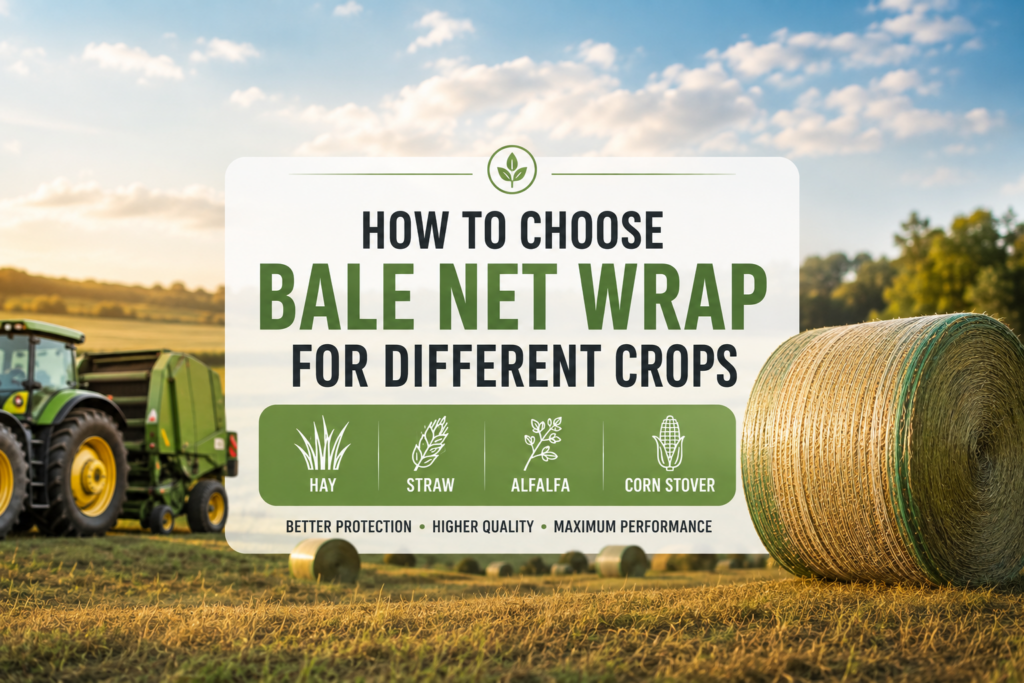
Harvesting high-quality forage starts in the field, but preserving that quality depends on proper bale protection. One of the most important decisions farmers make is selecting the right bale net wrap. While many operators use the same net wrap for every crop, different materials require different handling, bale density, and protection levels.
Understanding how crop characteristics affect wrapping performance helps reduce storage losses, minimize handling damage, and improve overall efficiency.
Why Crop Type Matters
Every forage crop has unique physical properties.
Hay is relatively soft and compressible.
Straw is dry, light, and often abrasive.
Alfalfa contains delicate leaves that are easily lost.
Corn stover produces heavier, rougher bales.
Because of these differences, bale density, expansion force, moisture content, and transportation requirements vary significantly. Choosing an appropriate net wrap ensures each bale maintains its shape throughout storage and transport.
Bale Net Wrap for Hay
Hay is the most common crop wrapped with net wrap. Since it is frequently stored outdoors for extended periods, maintaining bale integrity is essential.
A quality bale net wrap should provide:
- Excellent edge-to-edge coverage
- High tensile strength
- Reliable UV protection
- Uniform roll quality
- Consistent stretching during application
Premium net wrap helps maintain bale shape while reducing weather exposure. Better coverage also sheds rain more effectively, helping preserve forage quality.
Recommended Features
- UV stabilized material
- Strong longitudinal fibers
- Easy roll loading
- Roll end warning stripe
- Compatibility with all major baler brands
Bale Net Wrap for Straw
Although straw is much drier than hay, it presents different challenges.
Straw stems are stiff and abrasive, increasing wear on lower-quality net wrap. During transport, straw bales are also more likely to experience movement because they are lighter than hay bales.
A stronger net wrap helps prevent edge damage and minimizes material loss.
Best Practices
- Use high-strength net wrap.
- Ensure proper bale density.
- Apply recommended wrapping turns.
- Store bales on well-drained ground.
Bale Net Wrap for Alfalfa
Alfalfa is one of the highest-value forage crops. Every leaf contains valuable nutrients, making leaf retention critical.
Loose wrapping or insufficient bale compression allows excessive movement inside the bale, increasing leaf shatter during transport.
A premium bale net wrap supports tighter bale formation and reduces mechanical damage.
Advantages
- Better nutrient preservation
- Improved bale stability
- Lower dry matter losses
- Reduced transportation damage
Bale Net Wrap for Corn Stover
Corn stover produces heavy, coarse bales with irregular surfaces.
These bales create higher pressure against the net wrap, requiring excellent tensile strength and reliable edge coverage.
Low-quality products may tear during handling or transportation.
For corn residue, premium net wrap provides additional security while maintaining bale shape throughout storage.
Selecting the Correct Roll Width
Choosing the correct roll width is just as important as selecting the net itself.
Proper width provides complete edge-to-edge coverage, helping protect bale shoulders from weather damage.
Undersized rolls expose bale edges and increase spoilage risk.
Always verify compatibility with your baler model before purchasing.
UV Protection Matters
Most round bales remain outdoors for several months.
Without sufficient UV stabilization, polypropylene fibers gradually weaken under sunlight.
Premium net wrap includes UV additives that extend product life and help maintain wrapping performance during long-term storage.
Common Mistakes When Choosing Bale Net Wrap
Many operators focus only on price.
However, lower-cost products may increase total operating expenses due to:
- More broken rolls
- Higher replacement frequency
- Poor edge coverage
- Increased forage losses
- Additional labor
- Greater transportation damage
The purchase price represents only a small portion of the total harvesting cost.
Choosing a Reliable Supplier
When comparing suppliers, consider more than pricing.
Look for manufacturers that provide:
- Consistent product quality
- Modern production technology
- Strict quality control
- Stable UV formulation
- Worldwide distribution
- Technical support
- OEM and private label options if required
Long-term reliability is often more valuable than the lowest initial cost.
Conclusion
Every crop places different demands on bale net wrap.
Hay benefits from excellent weather protection.
Straw requires abrasion resistance.
Alfalfa needs secure bale formation to minimize leaf loss.
Corn stover demands maximum tensile strength.
Selecting a high-quality net wrap designed for your harvesting conditions helps improve forage preservation, reduce waste, and increase operational efficiency throughout the entire storage season.
Frequently Asked Questions
Can one bale net wrap be used for every crop?
Yes, premium universal net wraps are suitable for most forage crops. However, operators working with heavy or abrasive materials should prioritize products with higher tensile strength and excellent edge coverage.
How many wraps should be applied?
The recommended number depends on bale size, crop type, baler settings, and transportation distance. Always follow your baler manufacturer’s recommendations.
Does UV protection really matter?
Absolutely. UV stabilization helps maintain net strength during outdoor storage and reduces the risk of premature deterioration.
Is premium bale net wrap worth the investment?
In most operations, yes. Higher-quality net wrap reduces crop losses, minimizes downtime, improves handling efficiency, and often lowers the overall cost per bale despite a higher purchase price.
Looking for reliable bale net wrap for professional farming operations?
Polypak supplies premium bale net wrap designed for consistent performance, excellent coverage, and reliable protection across a wide range of crops. Contact our team to discuss the best solution for your harvesting requirements.