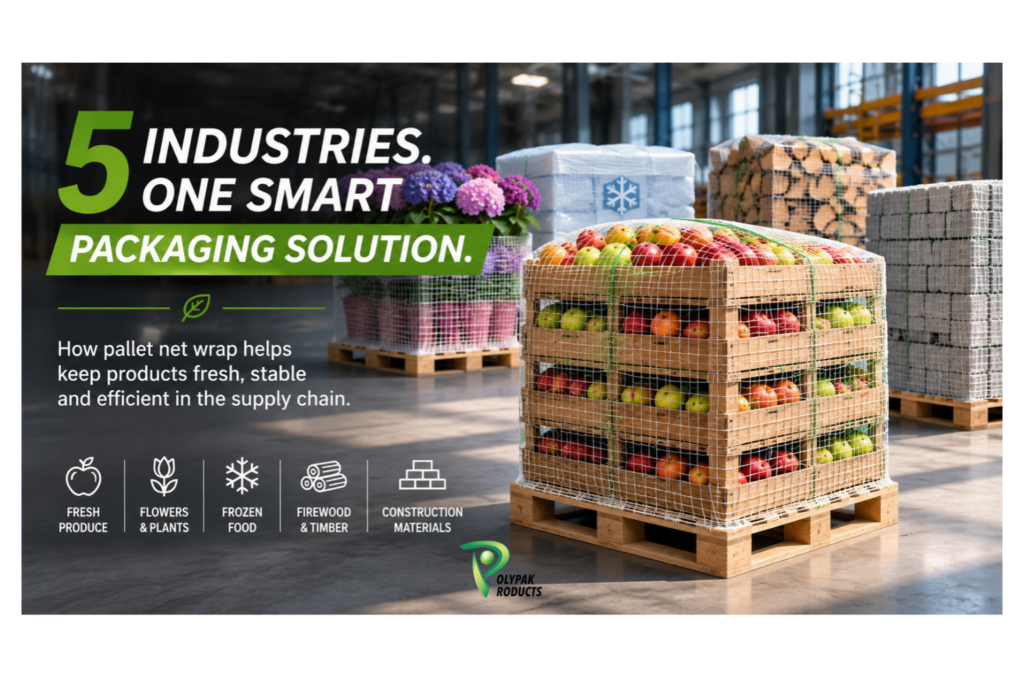
Discover how ventilated pallet packaging helps businesses improve airflow, protect products and optimize logistics.
Introduction: Does Every Pallet Need Stretch Film?
Stretch film has long been one of the most widely used solutions for securing palletized goods. It is flexible, easy to apply and effective at keeping products together during storage and transportation.
But not every product benefits from being enclosed in plastic film.
For fresh produce, flowers, temperature-sensitive goods and certain industrial materials, restricted airflow can create additional challenges.
Condensation, trapped heat and insufficient ventilation may affect product quality, increase handling requirements and complicate warehouse operations.
This is where pallet net wrap offers an alternative.
Unlike conventional stretch film, pallet net features an open mesh structure that allows air to circulate around packaged goods while helping maintain load stability.
For businesses that depend on ventilation, choosing the right pallet packaging can make a significant difference.
Let’s explore five industries where pallet net wrap can provide practical advantages over traditional stretch film.
1. Fruit and Vegetable Industry: Keeping Fresh Produce Ventilated
Fresh produce logistics requires careful control of temperature, humidity and airflow.
Fruits and vegetables continue biological processes after harvesting. Many products release moisture and heat, making ventilation an important consideration during storage and transportation.
When pallets are tightly wrapped with conventional stretch film, airflow around the load may be restricted.
Depending on the product, packaging configuration and storage conditions, this can contribute to moisture accumulation and uneven cooling.
How pallet net wrap helps
Pallet net secures crates, boxes and other packaging units without creating a continuous plastic barrier around the pallet.
Its open mesh structure allows air to move around the load, supporting temperature management and moisture release.
Key advantages include:
- Improved ventilation around palletized produce
- Reduced risk of moisture accumulation associated with restricted airflow
- Easier access for visual product inspection
- Secure grouping of boxes and crates
- Compatibility with suitable refrigerated storage and transport processes
Typical applications
Pallet net wrap can be used for transporting and storing:
- Apples and citrus fruits
- Potatoes and onions
- Leafy vegetables
- Fresh produce in ventilated crates
- Mixed pallets of agricultural products
For fruit and vegetable producers, packaging should support the conditions required to preserve freshness throughout the supply chain.
The key advantage: Pallet net helps maintain load stability without unnecessarily restricting the ventilation needed by fresh produce.
However, net wrap does not replace proper refrigeration, humidity management or product-specific storage procedures.
2. Flower and Plant Industry: Protecting Delicate Products
Flowers and ornamental plants are particularly sensitive to handling conditions.
Temperature changes, moisture accumulation and physical pressure can affect their appearance and commercial value.
For wholesalers, garden centres and flower distributors, product presentation is just as important as transportation efficiency.
Traditional stretch film may be suitable for some packaging operations, but completely enclosing pallets can restrict ventilation around plants.
Why pallet net is a practical solution
Pallet net wrap allows air to circulate while helping secure trays, cartons and other transport packaging.
Its flexible structure can accommodate different load shapes, making it useful for pallets containing products of varying dimensions.
Benefits include:
- Ventilation during transportation
- Reduced accumulation of trapped moisture
- Easier visual inspection of products
- Flexible wrapping of irregularly shaped loads
- Convenient handling in distribution centres
Typical applications
Pallet net is suitable for appropriately packaged:
- Cut flowers
- Potted plants
- Seedlings
- Ornamental plants
- Nursery products
For businesses transporting living plants, ventilation can be an essential part of maintaining product quality.
The key advantage: Pallet net combines load containment with airflow, helping logistics operators avoid completely enclosing temperature- and moisture-sensitive products.
The wrapping method should still be selected carefully to prevent damage to delicate leaves, stems and flowers.
3. Frozen Food and Cold Chain Logistics: Supporting Efficient Cooling
Temperature management is one of the most important factors in frozen food logistics.
Businesses operating refrigerated warehouses and freezing facilities need packaging that supports their cooling processes while keeping palletized products stable.
Traditional stretch film can create an additional barrier to airflow around packaged goods.
In applications where products must be cooled or frozen after palletization, this may affect how efficiently conditioned air reaches different parts of the load.
How pallet net supports temperature management
The open structure of pallet net allows refrigerated air to circulate more freely around palletized products.
This can be particularly useful in operations where airflow is part of the cooling or freezing process.
Potential advantages include:
- Improved access for circulating cold air
- Reduced obstruction of ventilation around the pallet
- Better moisture release where appropriate
- Secure pallet containment
- Compatibility with selected refrigerated warehouse operations
Typical applications
Pallet net can be considered for:
- Frozen food distribution
- Food processing facilities
- Products requiring cooling after packaging
- Refrigerated warehouses
- Temperature-controlled logistics centres
An important consideration
Pallet net does not automatically guarantee faster freezing or lower energy consumption.
Actual performance depends on product packaging, pallet configuration, airflow direction, refrigeration equipment and operating conditions.
Businesses should validate cooling performance under their specific conditions before changing their packaging system.
The key advantage: Pallet net can help reduce airflow restrictions around palletized products in operations where ventilation is essential.
4. Wood Processing and Firewood Industry: Reducing Moisture Accumulation
Wood products are another category where ventilation can play an important role.
Firewood, timber products and certain wood-based materials may retain moisture during storage and transportation.
When these products are completely enclosed in conventional stretch film, moisture may become trapped inside the palletized load.
Under unsuitable storage conditions, this can contribute to condensation and other moisture-related problems.
Why pallet net is suitable for wood products
Pallet net provides load containment while allowing air to circulate around the materials.
Its flexible structure can also accommodate irregularly shaped products that may be difficult to secure with conventional packaging.
Potential advantages include:
- Improved ventilation
- Reduced risk of trapped moisture
- Flexible wrapping of irregular loads
- Convenient visual inspection
- Secure grouping of packaged wood products
Typical applications
Pallet net can be used for:
- Packaged firewood
- Kindling
- Wood-processing products
- Selected timber products
- Other ventilated pallet loads
For firewood suppliers, allowing air to circulate around packaged products may help support appropriate storage conditions.
However, pallet net does not replace proper wood drying, weather protection or safe storage practices.
The key advantage: Pallet net secures wood products without forming a continuous barrier that restricts airflow.
5. Construction Materials: Securing Irregular and Ventilated Loads
Construction materials create different packaging challenges from food and agricultural products.
Loads may be heavy, uneven or irregularly shaped.
Products such as bricks, blocks and certain building materials require secure handling during warehouse operations and transportation.
In some cases, ventilation is also beneficial, particularly when materials contain residual moisture or are stored under changing environmental conditions.
How pallet net can help
Depending on the net specification, pallet net can adapt to the shape of the load while helping hold individual units together.
Elastic pallet net variants are especially relevant for products with irregular dimensions.
Potential benefits include:
- Flexible load containment
- Ventilation around packaged materials
- Easier identification and visual inspection
- Compatibility with selected manual and automatic wrapping systems
- Reduced use of continuous film where full coverage is unnecessary
Typical applications
Pallet net can be considered for:
- Bricks and blocks
- Roof tiles
- Selected construction products
- Building materials in bags
- Irregularly shaped industrial loads
Safety comes first
Pallet net must be selected according to the weight, geometry and transport requirements of the load.
For heavy construction materials, additional securing methods may be necessary.
A pallet net alone should never be assumed to provide sufficient transport restraint without appropriate testing and validation.
The key advantage: Suitable pallet net products can provide flexible containment and ventilation for loads that do not require full film coverage.
Pallet Net Wrap vs Traditional Stretch Film: Key Differences
Both pallet net and stretch film are valuable packaging materials.
The right choice depends on the products being transported, the required level of protection and the conditions throughout the supply chain.
| Feature | Pallet Net Wrap | Traditional Stretch Film |
|---|---|---|
| Air circulation | High, due to open mesh | Restricted |
| Moisture release | Supports ventilation | Can restrict moisture release |
| Protection from dust | Limited | Better coverage |
| Protection from rain | Limited | Better coverage, depending on wrapping |
| Load stability | Depends on net and application | Depends on film and application |
| Irregular loads | Flexible options available | Flexible options available |
| Cooling airflow | Less obstruction | Greater potential obstruction |
| Manual wrapping | Available | Available |
| Automatic wrapping | Available with compatible equipment | Available with compatible equipment |
| Material consumption | Depends on specification and application | Depends on specification and application |
| Recyclability | Depends on material and collection system | Depends on material and collection system |
The comparison highlights an important point:
Pallet net is not intended to replace stretch film in every application.
Instead, it provides a specialized solution for products that require ventilation alongside reliable load containment.
How to Choose the Right Pallet Net Wrap
Not all pallet net products offer the same characteristics.
Before selecting a packaging solution, businesses should evaluate several technical factors.
1. Load weight and geometry
Heavy or irregularly shaped loads may require different net strength and elasticity characteristics.
2. Required ventilation
Products that need rapid cooling or continuous airflow may benefit from a more open packaging structure.
3. Wrapping equipment
Confirm whether the product is designed for manual wrapping, automatic wrapping or both.
4. Elongation properties
Different levels of elasticity affect how the net adapts to the load and maintains tension.
5. Storage and transport conditions
Consider humidity, temperature, handling frequency and the need for protection against external contamination.
6. Packaging cost per pallet
Compare actual material consumption, labour requirements, wrapping time and product losses rather than relying only on the price per roll.
The best packaging solution should meet the technical requirements of the load while supporting efficient warehouse operations.
Polypak Pallet Net: Packaging Designed for Ventilation and Flexibility
Polypak offers pallet net solutions for businesses that need reliable load containment combined with excellent airflow.
Manufactured from high-density polyethylene (HDPE), Polypak pallet net is designed for a variety of industrial and agricultural packaging applications.
The product range includes different levels of elongation to accommodate varying load requirements.
Polypak pallet net options
Classic Polyflow® CP
A solution for applications where secure pallet containment and ventilation are required.
Elastic Polyflow® 20%
Designed for applications that benefit from additional flexibility and load conformity.
Ultra Polyflow® 50%
An option for applications requiring greater elongation and adaptability to load shapes.
Polypak pallet net offers:
- Open mesh structure for ventilation
- HDPE construction
- Options for manual and automatic application
- Different sizes and specifications
- Elongation options from 15% to 50%
- Custom production possibilities
- Recyclable material
The appropriate variant should be selected according to the product, load geometry and wrapping equipment.
Conclusion: Better Packaging Starts with Understanding Your Product
Traditional stretch film remains an effective solution for many logistics applications.
However, for products that require ventilation, pallet net wrap can provide significant practical advantages.
From fresh produce and flowers to frozen food, firewood and construction materials, the open mesh structure helps businesses combine load containment with airflow.
The result is a packaging solution that can support product quality, handling efficiency and operational flexibility.
The most important question is not whether pallet net is universally better than stretch film.
It is:
Does your product need to breathe?
If the answer is yes, pallet net may be the right packaging solution for your business.
Discover Polypak Pallet Net Solutions
Looking for ventilated packaging for your products?
Explore the Polypak pallet net range and find a solution that matches your industry, load requirements and packaging equipment.