For decades, twine was the standard method for securing round bales. However, as agricultural operations have become larger and more efficiency-driven, bale net wrap has increasingly replaced twine in many regions.
Today, farmers face an important question: Should I continue using twine, or is net wrap the better investment?
The answer depends on several factors, including operation size, labor costs, forage quality requirements, and storage conditions. In this article, we compare both solutions and explain why more farms are switching to net wrap.
Understanding the Difference
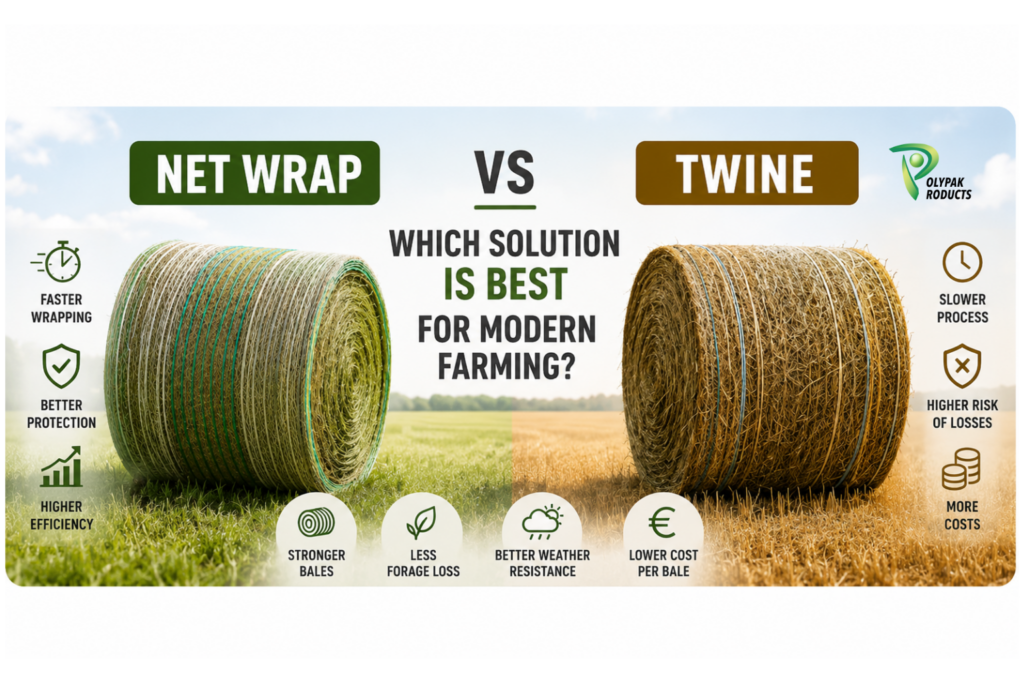
Twine secures a bale using multiple strands wrapped around its circumference. Net wrap, on the other hand, covers the entire surface of the bale with a lightweight mesh material.
While both methods hold the bale together, their performance differs significantly in terms of speed, protection, and overall efficiency.
Wrapping Speed and Productivity
One of the biggest advantages of net wrap is wrapping speed.
When using twine, a baler typically requires several revolutions to secure a bale properly. Net wrap usually requires only a few rotations to cover the bale completely.
Typical comparison:
| Factor | Net Wrap | Twine |
|---|---|---|
| Wrapping time per bale | 5–10 seconds | 20–40 seconds |
| Number of rotations | 2–4 | Multiple |
| Downtime | Lower | Higher |
For a farm producing thousands of bales per season, these seconds quickly add up.
For example, a farm producing 5,000 bales annually could save dozens of working hours simply by switching from twine to net wrap.
Bale Shape and Density
A well-formed bale is easier to transport, stack, and store.
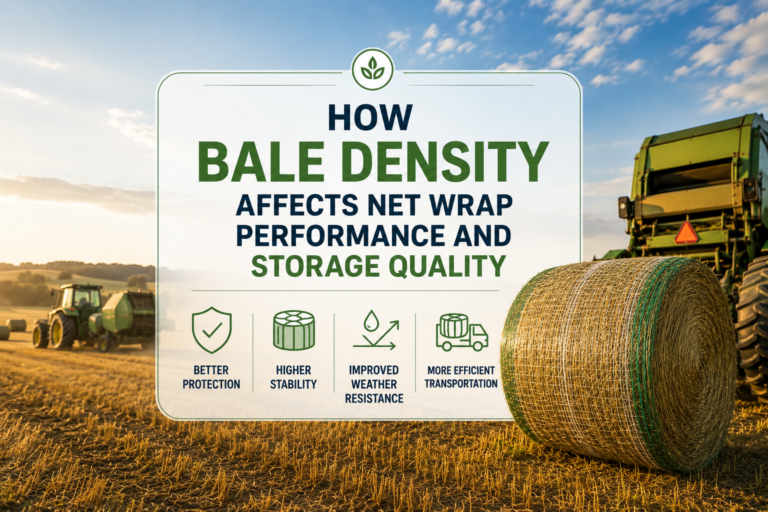
Net wrap applies uniform pressure across the entire surface of the bale, helping maintain its shape and density.
Benefits include:
- better bale integrity
- improved handling
- reduced deformation during transport
- easier stacking
Twine secures the bale only at specific points, leaving larger sections exposed.
As a result, twine-wrapped bales often lose shape more quickly, especially during repeated handling.
Forage Protection
Protecting forage quality is one of the most important objectives in bale production.
Net wrap provides better surface coverage and helps reduce leaf and forage losses.
This is particularly important for:
- alfalfa
- hay
- high-value forage crops
Research and field experience consistently show that net wrap can reduce dry matter losses compared to twine, especially during storage and transport.
Even small reductions in forage loss can create significant savings over an entire season.
Weather Resistance
Round bales are frequently stored outdoors.
In these conditions, exposure to rain, wind, and sunlight can affect forage quality.
Because net wrap covers a larger surface area, it helps create a smoother outer layer and sheds water more effectively than twine.
When combined with UV-stabilized materials and proper storage practices, net wrap contributes to improved bale preservation.
Transportation and Handling
Every time a bale is moved, there is a risk of material loss.
Net wrap helps maintain bale stability during:
- loading
- transportation
- stacking
- feeding operations
Many operators report fewer damaged bales and less forage loss during handling when using net wrap.
This becomes increasingly important as transport distances grow.
Cost Comparison
At first glance, twine often appears less expensive.
However, focusing only on purchase price can be misleading.
The real cost includes:
- labor
- machine productivity
- downtime
- forage losses
- transportation efficiency
Hidden costs of twine:
- longer wrapping cycles
- more machine wear
- increased forage loss
- lower productivity
Benefits of net wrap:
- faster baling
- reduced labor requirements
- improved forage preservation
- greater operational efficiency
For many medium and large farms, the overall cost per bale is often lower when using net wrap.
When Twine Still Makes Sense
Twine remains a practical solution in some situations.
It may be suitable for:
- small farms producing limited numbers of bales
- operations with older equipment
- situations where labor costs are less critical
- short-term storage applications
For farms producing only a few hundred bales annually, the productivity gains of net wrap may be less significant.
When Net Wrap Is the Better Choice
Net wrap is typically the preferred option for:
- commercial farming operations
- contractors
- livestock producers
- high-value forage production
- farms storing bales outdoors
The larger the operation, the greater the benefits become.
As labor costs rise and efficiency becomes more important, net wrap offers clear advantages.
Expert Conclusion
Both twine and net wrap can successfully secure a bale.
However, modern farming increasingly prioritizes efficiency, forage quality, and productivity.
While twine may remain suitable for smaller operations, net wrap delivers significant advantages in:
✔ wrapping speed
✔ bale stability
✔ forage protection
✔ handling efficiency
✔ overall profitability
For most professional farming operations, net wrap is no longer simply an alternative to twine—it is a tool for improving operational performance and reducing long-term costs.
Looking for the right net wrap solution?
Our specialists can help you choose the optimal net wrap based on your baler, crop type, and operational requirements.