Modern forage harvesting places significantly higher demands on bale net wrap than it did 10–15 years ago. Increased baler productivity, higher bale densities, stricter requirements for forage preservation, and at the same time tighter environmental regulation in the EU and other regions are driving continuous technological innovation among net wrap manufacturers.
At the same time, the core objective of the industry remains unchanged: to ensure the most reliable bale containment with minimal material consumption and minimal operational risk for the farmer.
Below, we outline three of the most impactful technological directions that are currently shaping the development of bale net wrap and are already being applied in practice.
1.High-strength multilayer structures with optimized fibre orientation
Technology overview
One of the key development trends in bale net wrap is the shift from homogeneous monofilament designs to multilayer structures with controlled orientation of polymer chains. Modern extrusion technologies make it possible to produce strands with different density and strength across individual layers, resulting in a more even load distribution during bale wrapping.
As a result, the net wrap:
- offers improved resistance to tearing under high baling pressure;
- maintains stable geometry under elongation;
- reduces the risk of localized damage and crop “cut-through”.
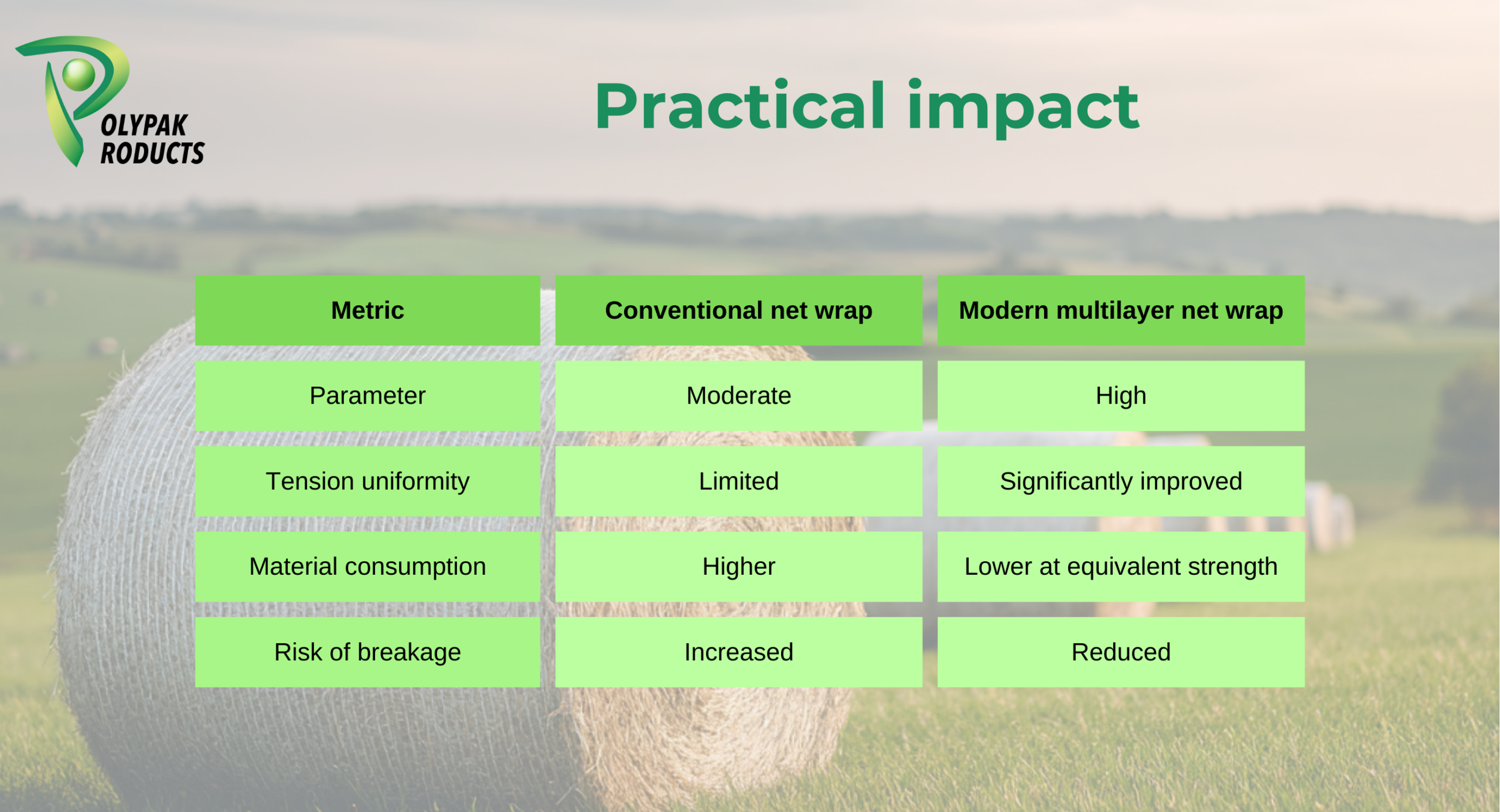
By using raw material more efficiently, manufacturers are able to reduce the overall weight of the net without compromising mechanical performance. This has a direct positive impact on both product economics and environmental footprint.
2.Intelligent calibration of net tension during wrapping
What this actually means
It is important to clarify that bale net wrap itself does not contain electronic components. Intelligent tension calibration is the result of synergy between net wrap design and the control systems of modern balers.
Contemporary net wraps are engineered with:
- precisely defined elongation characteristics;
- a stable modulus of elasticity throughout the entire roll length;
- predictable behaviour under dynamic load.
This enables balers equipped with electronic tension control systems to automatically adjust wrapping parameters based on:
- forage density and moisture content;
- bale diameter;
- operating speed of the machine.
Why it matters
Unstable net tension is one of the primary causes of:
- bale deformation;
- uneven edge density;
- increased net consumption.
Net wraps optimized for intelligent baling systems ensure consistent, repeatable results from bale to bale, even under changing operating conditions.
Key benefits
- denser and more uniform bale shape;
- fewer wraps required without loss of containment;
- reduced mechanical stress on baler components;
- increased overall harvesting productivity.
3. Environmental solutions: material reduction and recyclability
A realistic view on “eco-friendly” net wrap
Despite ongoing research into biopolymers, there are currently no commercially available fully biodegradable bale net wraps that meet industrial requirements in terms of:
- mechanical strength;
- UV resistance;
- moisture resistance;
- stability throughout the entire forage storage cycle.
Biodegradable and oxo-degradable materials either fail to deliver the necessary mechanical performance or lead to microplastic formation, making them unsuitable for agricultural use—particularly under European regulatory frameworks.
Practical environmental innovations in the industry
Modern manufacturers are focusing on realistic and verifiable solutions:
- reducing net weight through increased specific strength;
- optimizing filament and mesh structure to minimize raw material usage;
- adopting monomaterial designs;
- improving recyclability of net wrap;
- reducing plastic residues left in the field after net removal.
Recycling and circular economy
In many EU countries, dedicated collection and recycling programs for agricultural plastics are already in place. Bale net wrap made from high-quality polyethylene can be recycled after proper collection and cleaning, significantly reducing the overall environmental impact of forage harvesting.
- Reduced net weight results in lower raw material use per bale.
- Higher strength leads to fewer breakages and less waste.
- Improved recyclability reduces the environmental burden.
Conclusion
The development of bale net wrap today is not driven by high-profile but technically unviable concepts, but by engineering optimization, predictability, and long-term sustainability.
High-strength multilayer structures, adaptation of net wrap to intelligent baling systems, and a practical—not declarative—approach to environmental responsibility are shaping a new generation of products that enable farmers to:
- increase forage harvesting efficiency;
- reduce operating costs;
- comply with modern sustainable agriculture requirements.
These technologies will define the competitive landscape of professional bale net wrap manufacturers in the years to come.