Maximizing the benefits of hayby testing its quality
High-quality hay has a high concentration of various nutrients, good digestibility and high consumption potential. This increases the efficiency of feedstuff use.
In order to effectively market hay or properly distribute it to different classes of livestock, accurate laboratory tests that can evaluate the nutritional profile of the feedstuff are required. This process can be complex, but it is critical both for marketing if you are a hay dealer and for ensuring optimal feeding if you have your own herd.
Why is hay testing necessary?
Hay testing is performed for several purposes:
- Establishing a fair price for hay: Understanding nutrients helps in the negotiation process with buyers, as the quality of the feedstuff affects the price.
- Divide hay by livestock class: Different classes of livestock require different levels of nutrients. The analysis allows you to correctly distribute hay by animal category (for example, for dairy or beef cows, as well as lactating or expecting offspring).

- Diet Enrichment: Testing helps identify which nutrients are missing from the feedstuff and add the necessary supplements or other feeds.
That is why it is important to make an informed decision about suitable packaging materials and storage methods for feedstuff even before the stage of its preparation. We recommend Polypak‘s bale net wraps both for packing hay into bales and for pre-wrapping bales before packing with stretch film.
Standardization of hay testing
To improve the accuracy of hay testing and increase confidence on the part of both producers and consumers, the National Feed Testing Association (NFTA) was created in the United States in 1984, uniting the American Grass and Feed Council (AFGC), the National Hay Association ( NHA) and feedstuff testing laboratories. All NFTA-certified laboratories are subject to regular certification, so their results are the most accurate. When testing, it is better to use only such laboratories. Of course, other countries have their own standards, which may differ in some ways.
Hay testing is carried out using two main methods: traditional chemistry and NIRS – where uses light reflectance. The first method is more expensive and time-consuming, but it provides accurate results. NIRS is used more often due to its speed and lower cost, although it may be less accurate for some complex samples. However, this method is quite suitable for samples from a single source, where there is only one type of feedstuff. Some NFTA certified laboratories use both methods, while others use only one.
What parameters need to be tested?
In order to correctly assess the quality of hay, you need to pay attention to several key parameters:
- Neutral Detergent Fiber (NDF) and Digestible Neutral Detergent Fiber (dNDF) – These parameters determine fiber content and digestibility. dNDF can vary greatly depending on the type of feedstuff and its maturity.
- Crude Protein (CP) – Protein is an essential nutrient for livestock and should be closely monitored in hay.
- Total Digestible Nutrients (TDN) – This data is used to calculate the energy value of hay. It is important to consider several parameters when calculating TDN, and it is best to use a summary estimate rather than calculating TDN based on the acid detergent fiber (ADF) value.
- Relative Feed Quality (RFQ) Index – This index more accurately reflects the quality of grass hay than the old Relative Feed Value (RFV) index and is a useful tool for marketing and allocating hay to livestock classes.
- Ash Content – If the ash content exceeds 10%, it may indicate soil contamination, which reduces the digestibility of the hay and can cause health problems for livestock.
Of course, all these indicators will be better understood and interpreted by your technologist.
Sampling rules
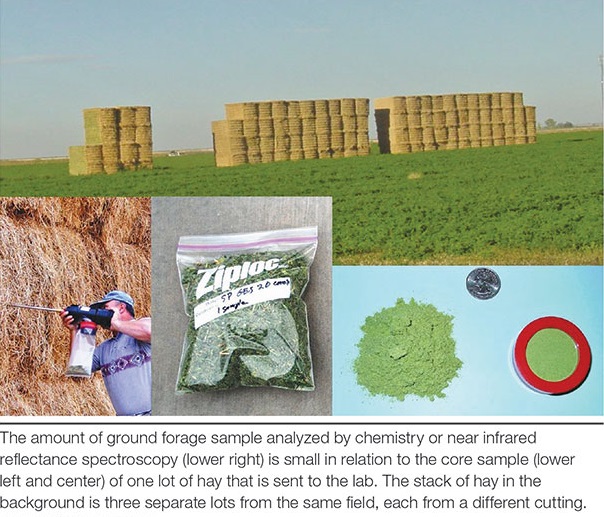
Correct sample selection is critical to obtain accurate test results. It is recommended to use a probe that can sample different parts of the hay bale to ensure the sample is representative. Here are some recommendations for proper selection:
- Number of samples: For one lot of hay, a minimum of 20 samples should be taken from different parts to obtain an average value.
- Proper use of the instrument: The sample should be taken using a good probe with a sharp tip to easily penetrate the hay and extract the amount required for analysis. It is better to choose a probe that has been approved by the laboratory you have chosen for research.
- Sample storage conditions: After collecting samples, they should be sent to the laboratory as soon as possible or stored in a cool place, avoiding exposure to heat or direct sunlight, so as not to affect the results.
You can also ask the laboratory for a sample collection protocol to help you do it correctly.
Qualitative sample analysis also always includes physical analysis, that is, evaluation by sight, smell and touch.
Checklist for choosing a sampler
It is important to select the correct probe for testing. This is an instrument that should easily penetrate the hay and extract the sample while maintaining its representativeness. Here’s what you should pay attention to when choosing:
- The point should be sharp and easily pierce the hay.
- Probe shaft length should be 12-24 inches to ensure the sample is collected at an appropriate depth.
- The sample should collect approximately 250 grams of material from 20 points, which equates to half a pound.
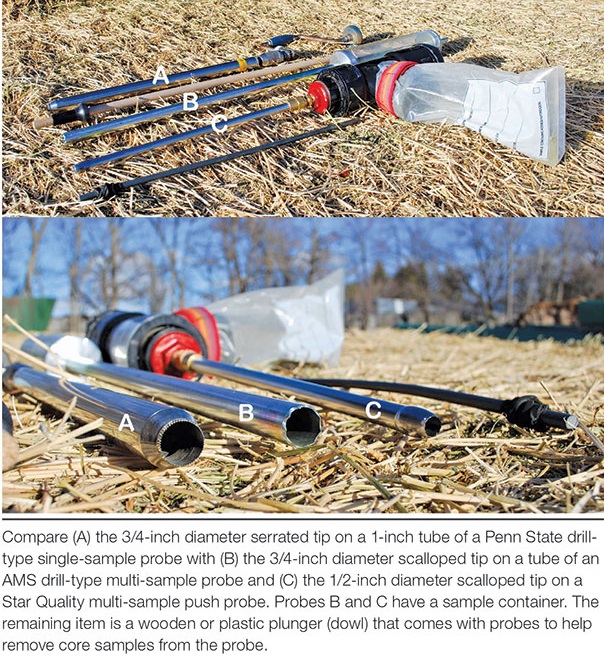
Some additional tips when taking a sample
- Determine the party you plan to research. Please note that if the difference between the packaging of bale net wraps standing next to each other is 1-2 weeks or more, then they should be considered as separate batches.
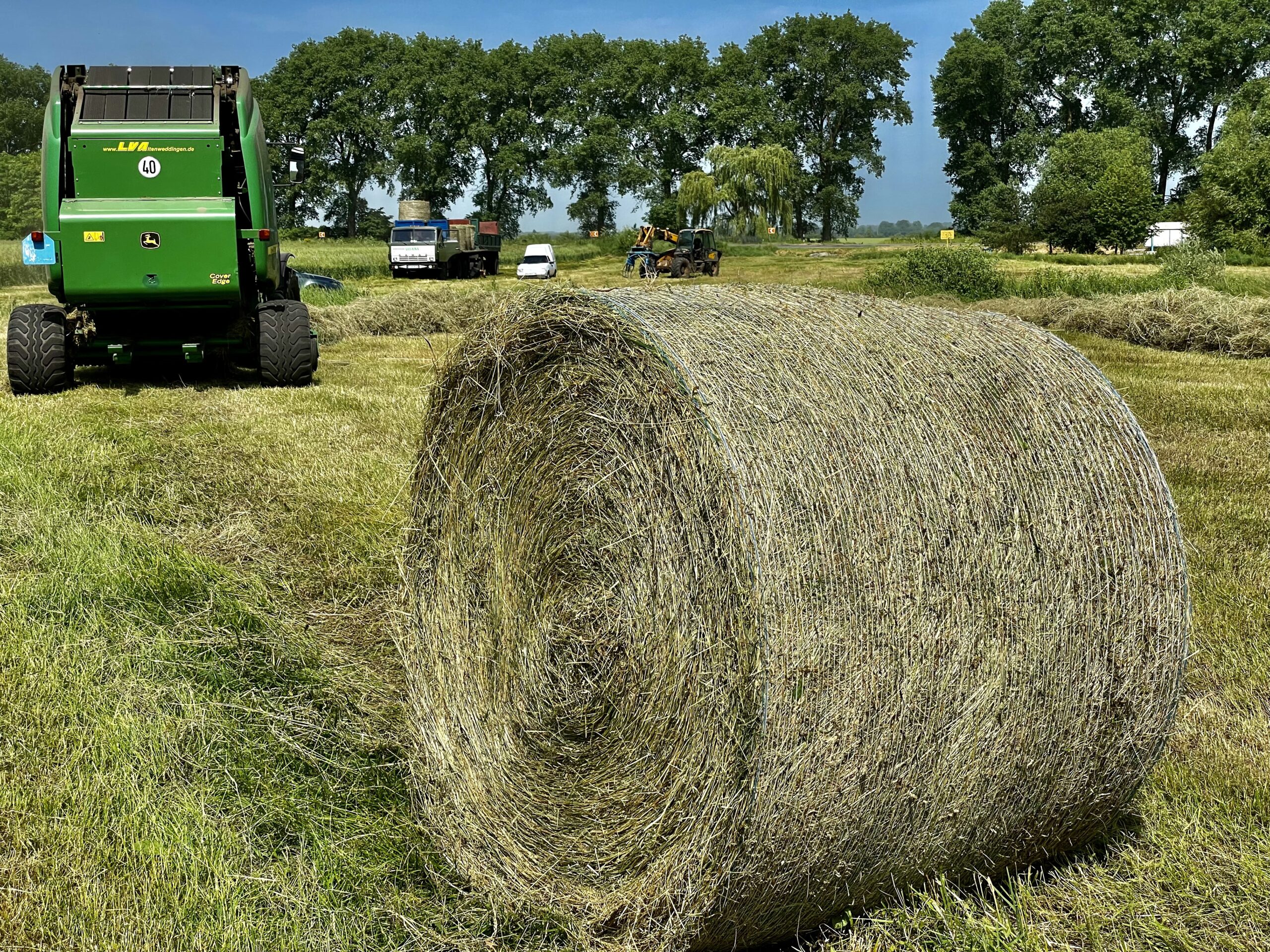
- Rectangular bales should be probed from the end as close to the center as possible. Round bales should be probed from the curved side.
- Probes that do not have a dedicated sample container should be emptied after each sample. Thus, having a container on the sampler greatly speeds up the sampling process.
- Samples should be taken from different random or predetermined locations in the lot for the most objective sampling.
- Samples from the same batch can be combined into one or more. They should be stored in sealed bags in a cool place away from heat and direct sunlight. You can also freeze samples if the time between sample and delivery to the laboratory is more than a few hours. However, check the laboratory rules for this (duration, temperature conditions, transportation, etc.).
- Each container you submit to the laboratory is a sample of the feedstuff. It must be identified by date, cut, feedstuff type, location and owner.
- Do not split an unground sample to try to “test the labs” as this will almost certainly lead to different results.
What we’d like to add is that you can’t manage what you don’t measure. This is why regular feedstuff testing is so important. Without them, you will not be able to build your business truly competently and profitably, regardless of your role — a farmer or a feedstuff seller. However, we should not forget about other important points that are directly responsible for the quality of your hay: timely harvesting and proper packaging. Use the Polypak‘s bale net wrap to retain the maximum beneficial properties of the herbs in your bales.