Pallet net is an effective solution for securing and protecting goods in logistics. It helps prevent load shifting on the pallet and reduces the risk of mechanical damage, especially during the transportation of long and oversized cargo. However, in practice, cargo damage can still occur even when pallet netting is used. Understanding the causes of such damage and the ways to prevent it significantly improves the quality of logistics operations and reduces financial losses.
Why damage occurs despite the use of netting
Main mechanisms of damage
1. Insufficient load securing
Pallet netting on its own provides limited securing, especially under lateral and vertical dynamic loads. If the cargo is improperly distributed or the netting is not fixed correctly, load shifting may occur during braking or cornering, leading to deformation or destruction of the goods.
2. Mismatch between netting and cargo parameters
The selection of netting in terms of size, strength, and material must correspond to the characteristics of the cargo. Incorrectly selected netting may not withstand the forces generated by acceleration and vibration, particularly in the case of heavy or fragile goods.
3. External impacts and loading/unloading processes
Damage often occurs outside the transport phase: during loading and unloading, contact with other pallets, or handling by equipment. These factors are not always compensated for by netting alone.
4. Vibrational and dynamic loads
Vehicle movement dynamics (road unevenness, manoeuvring) generate vibrations that, in the case of insufficient securing, still lead to load shifting within the pallet unit.
Statistics on securing failures
According to studies, up to 25 % of freight transport accidents are directly caused by unreliable load securing, which also includes insufficient fixation on the pallet.
Analysis of damage causes
Table 1. Main causes of cargo damage and damage mechanisms
| Cause | Damage Mechanism | Impact on Cargo |
| Incorrect netting selection | Insufficient strength or incorrect size | Load shifting, compression of goods |
| Incomplete securing | Netting not tightened or not fixed | Lateral movement, falling |
| Incorrect weight distribution | Shifted centre of gravity | Pallet distortion, pressure on one sector |
| Vibrational and dynamic loads | Load stress during movement | Packaging wear, cracks |
| Improper loading/unloading | Impacts, drops | Surface and structural damage |
How to minimise the risk of damage
1. Correct selection of net and accessories
The selection of pallet netting should take into account:
- Cargo and pallet dimensions
- Cargo weight and dynamic loads
- Material strength and standards (e.g. ISO or EN for netting with certified strength)
- Possibility of combined use with straps, corner protectors, and other securing devices
2. Integrated load securing
In many cases, netting alone is not sufficient. It is recommended to combine it with other securing methods:
- Tension straps and tie-downs
- Blocking corner protectors and spacers
- Rigid separators and packaging materials
This helps prevent lateral and vertical load movement that netting alone cannot always compensate for.
3. Weight control and distribution
Cargo should be positioned so that its centre of gravity is as close as possible to the geometric centre of the pallet. This reduces stress on individual sections of the netting and improves overall stability.
Practical action algorithms
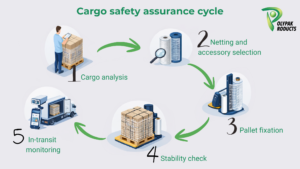
Pre-shipment inspection process
Stage 1. Cargo assessment
- Identification of cargo type (fragile, heavy, bulk)
- Analysis of dimensions and weight
Stage 2. Selection of securing equipment
- Selection of netting with appropriate strength
- Decision on the use of additional straps
Stage 3. Standardised packaging
- Application of netting with simultaneous tension control
- Installation of corner protectors and spacers
Stage 4. Stability check
- Vibration and displacement testing with light manual impact
- Quality control of load securing
Conclusion
The use of pallet netting remains an important element of cargo protection systems; however, it does not provide an absolute guarantee against damage. In most cases, damage is caused not only by the limitations of the netting itself, but also by errors in selection, securing, weight distribution, and external influences. A comprehensive approach — including correct material selection, standardised packaging processes, controlled weight distribution, and consistent stability checks — significantly reduces the risk of cargo damage even in complex logistics operations.