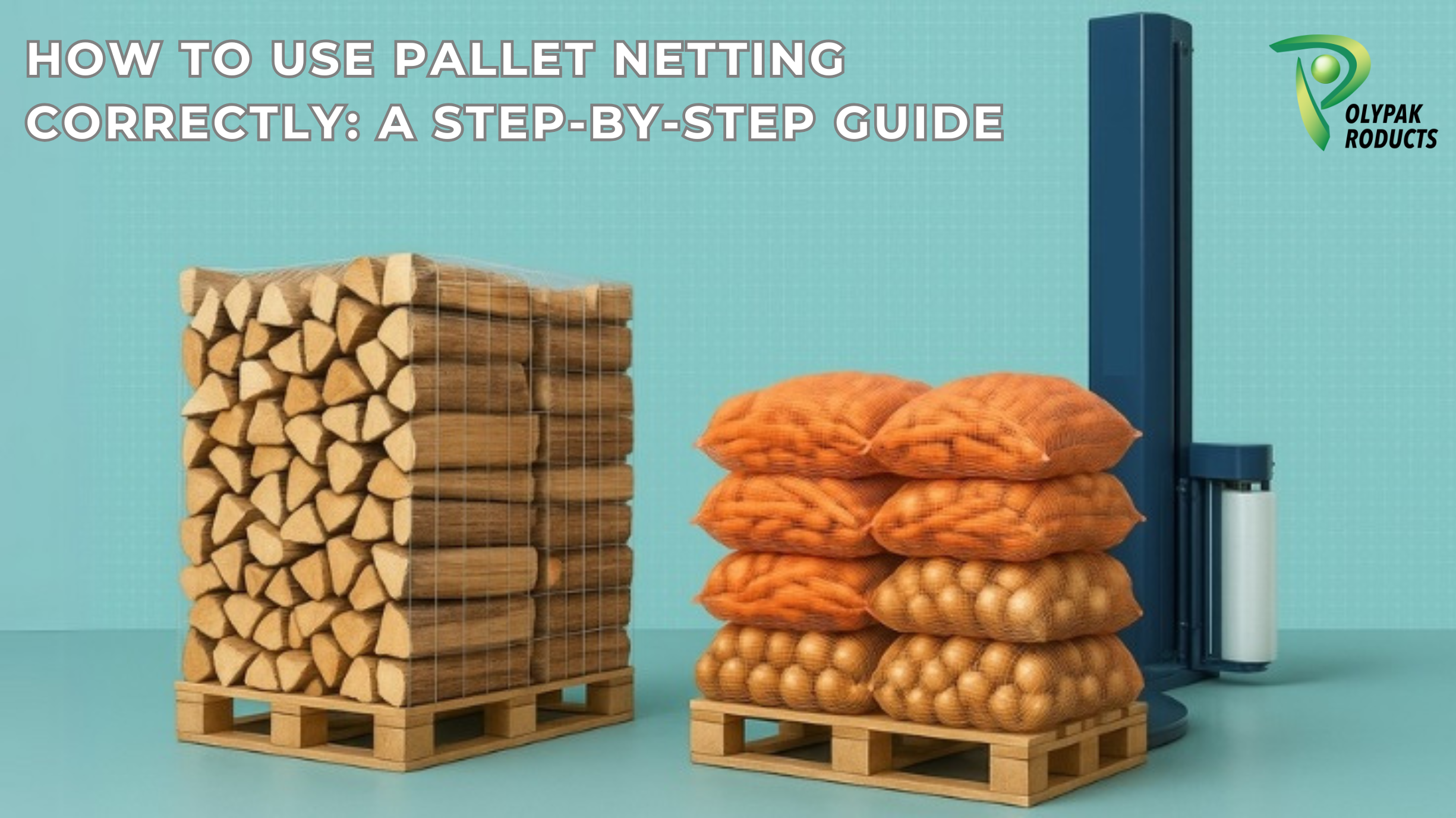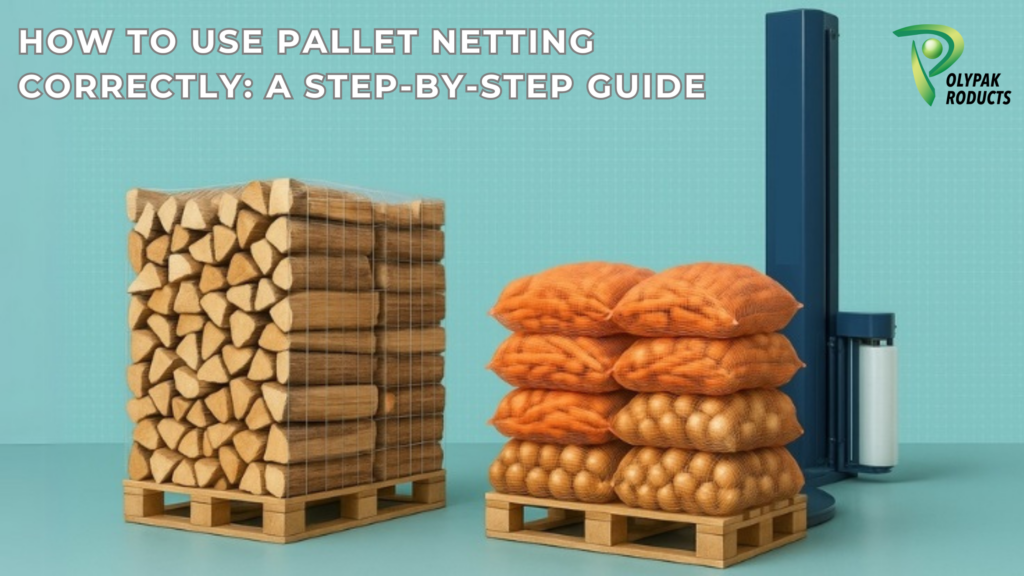
Pallet netting (pallet net, pallet nets, net wrap) is a lightweight mesh solution for securing loads on a pallet. In comparison with solid stretch film, the net provides ventilation, reduces the risk of condensation and spoilage of perishable goods, often speeds up the packaging cycle, and decreases the volume of single-use plastic when processes are properly organized. Practical advantages are noted by both manufacturers and users in agricultural and food logistics.
Step-by-step guide
Step 1. Preparation
- Assess the load. Determine the configuration, weight, centre of gravity, and sensitivity to moisture/condensation.
- Choose the height and width of the net. For a standard Euro pallet (1200×800 mm), select a net that covers the full height of the load or the required levels.
- Check the pallet. Pallets must be intact, without cracks; the load must be stacked evenly, without “hanging” boxes.
Why this matters: an unstable base increases the risk of shifting during transport.
Step 2. Load placement and preparation for wrapping
- Place heavier items at the bottom; minimize empty spaces between boxes.
- Use cardboard pads/corners if necessary to protect edges.
If the product is fragile, apply internal stabilisers (rods, spacers) before wrapping.
Step 3. Applying the pallet netting
- Securing the beginning. Tuck the end of the net under the pallet corner or secure it at the base so it does not slip during rotation of the wrapper.
- Initial wraps at the base. Make 2–3 circular rotations at the pallet base (to stabilise the centre of gravity).
- Upward movement and even tension. Move upward in a spiral; tension must be sufficient for fixation but not so strong as to deform the load.
- Cross reinforcement. At critical points (middle, top), apply cross-wraps to increase rigidity.
- Finishing. Complete 2–3 rotations at the top, then return downward and secure the end. Cut and tuck the tail of the net (if the design allows).
- Inspection. Press from the side and pull slightly — the load must not shift beyond the acceptable range.
Equipment recommendations
- Manual vs automatic wrapper. For large volumes, invest in automated equipment — speed and repeatability are higher; manual application is suitable for smaller operations.
- Tension parameters. On automatic machines, control rotation speed and tension force; for light or sensitive loads, reduce the tension. Optimal settings depend on the machine model — follow the technical documentation.
Quality control and testing
- Visual inspection: net integrity, absence of snags, correct securing.
- Static tests: manual shifting to assess holding strength.
- Dynamic tests: vibration/impact tests (laboratory methods). These tests are used in studies of load stability and show the importance of correct stacking and wrapping parameters. Results indicate that proper technique is often more important than material thickness.
Practical recommendations and pre-shipment checklist
- Stack without protrusions and with even weight distribution.
- Use corner protectors/cardboard for fragile goods.
- Minimum 2–3 wraps at the base and at the top.
- Cross-wraps at mid-height for unstable containers.
- Clear labelling and seals if required.
- Documented quality control procedure and incident log.
Conclusion
Pallet net is an effective means of stabilising and protecting loads for specific product categories, especially where ventilation and reduction of single-use plastic are essential. The key to successful use is correct load assessment, proper material selection, and strict adherence to the application technique. By combining standardised operational procedures with periodic stability testing and environmental considerations, companies can increase transport safety and reduce operational costs.