Modern agriculture is rapidly evolving under the influence of several stable technological and economic trends: automation, higher efficiency, responsible use of resources, reduction of forage losses, and the growing importance of sustainability. In this context, bale net wrap is no longer just a consumable, but an integral part of modern forage-handling technology.
For dealers, this means increasing demand for more efficient solutions. For farmers, it means an opportunity to reduce costs and improve the quality of their forage base.
The trend toward efficiency and time savings
One of the key industry trends is the rising cost of labour and machinery. Farmers need to pack as much forage as possible within short weather windows. Therefore, bale-wrapping technology must be fast and reliable.
Why net wrap aligns with this trend:
- Wrapping with a bale net wrap takes 3–4 times less time than wrapping with twine.
- More bales per shift mean higher baler productivity.
- Fewer stops and lower fuel consumption.
Benefits for dealers and farmers:
- Dealers can offer their customers a real, measurable time saving from the very first season.
- Farmers gain flexibility in planning fieldwork without being limited by long wrapping cycles.
The trend toward minimising forage losses and improving quality
Preserving the nutritional quality of grass or straw is a core objective for any farm. Losses during storage translate directly into financial losses.
How bale net wrap fits this trend:
- It forms a dense and uniform bale surface.
- It reduces moisture penetration.
- It decreases deformation during storage and transport.
As a result, farmers see less spoilage, fewer issues with mould, and lower waste during feeding.
The trend toward sustainability and environmental responsibility
Agriculture is moving toward responsible resource use and reduced emissions — this is reflected in EU policy and in the requirements set by milk and meat processors.
What net wrap provides:
- Lower fuel use during baling means a smaller carbon footprint.
- Better forage preservation results in fewer discarded materials.
- Modern net wraps are typically produced from mono-material polymers, making them recyclable where collection systems exist.
For dealers, this is an opportunity to offer a product that meets the demands of sustainable farming.
The trend toward convenience and reduced load on machinery
Farmers value ease of use and fewer interruptions. Dealers increasingly seek solutions that reduce service claims and increase the baler’s output.
Net bale wrap supports this:
- Lower risk of material jamming.
- Consistent tension during operation.
- Predictable bale formation.
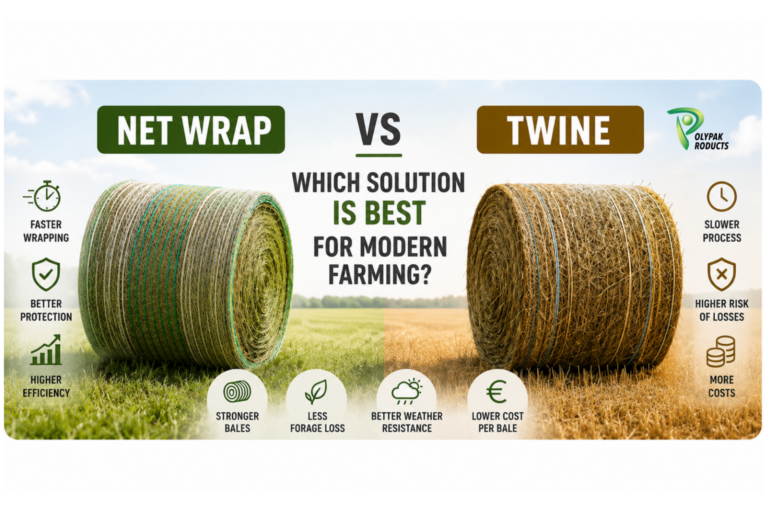
Comparing net wrap and twine within modern agricultural trends
To clearly illustrate how net wrap meets today’s market expectations, the improved table below is integrated into the article content.
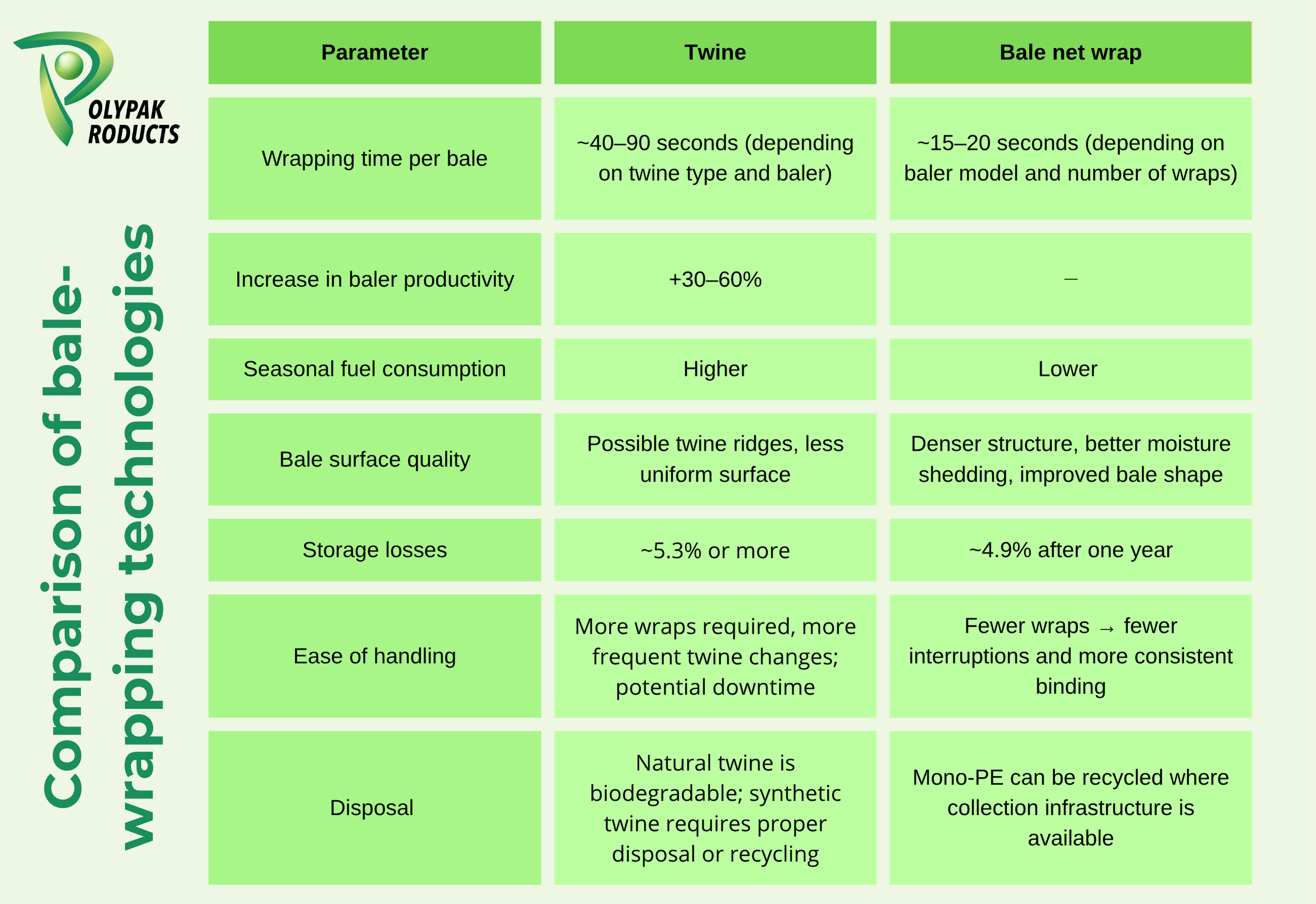
This comparison shows that net wrap is a natural response to the needs of modern farms, where speed, quality, and overall efficiency are essential.
Key considerations for dealers and farmers
To ensure that bale-wrapping technology performs at its best, several factors should be taken into account. The points below are adapted specifically for dealers and farmers — not risks, but practical aspects that influence product choice and performance.
Bale storage conditions
For long-term outdoor storage, net wrap provides a denser surface and lowers the risk of degradation.
Baler type and settings
Recommended tension settings and revolutions must be followed. Dealers can assist farmers in optimising baler adjustments.
Climate specifics
In wetter regions, net wrap is particularly beneficial due to better moisture protection.
Local recycling infrastructure
If a region has a collection point for agricultural film and net wrap, this increases the appeal for sustainability-focused farms.
Farm workload
The larger the number of bales produced per season, the more noticeable the time and fuel savings when using net wrap.
These considerations help dealers choose the right product for each customer and allow farmers to maximise operational benefits.
Conclusion
Bale net wrap fits naturally into key modern agricultural trends — efficiency, sustainability, resource optimisation, and improved forage quality. Thanks to reduced wrapping time, lower storage losses, and the possibility of recycling, net wrap has become the preferred choice for farmers who aim to streamline processes and improve profitability.
For dealers, this positions net wrap as a technically advanced and increasingly in-demand solution that meets the expectations of today’s agricultural market.