Why and hownet wrap increases machinery productivity

The efficiency of round bale pressing directly affects the cost of forage production and the overall profitability of a farming operation.

One of the most effective ways to improve productivity is to use bale net wrap instead of traditional baler twine.

The principle of net wrap operation

Net bale wrap is used to bind bales of hay, straw, or silage.

Unlike twine, which creates multiple individual loops, the net evenly covers the surface of the bale, forming a dense and stable wrapping.

This even distribution of tension provides:

  • a more uniform and compact bale shape;
  • reduced material losses during transportation;
  • improved stability during storage.

Reduced baling time

Using net wrap significantly speeds up the binding process.

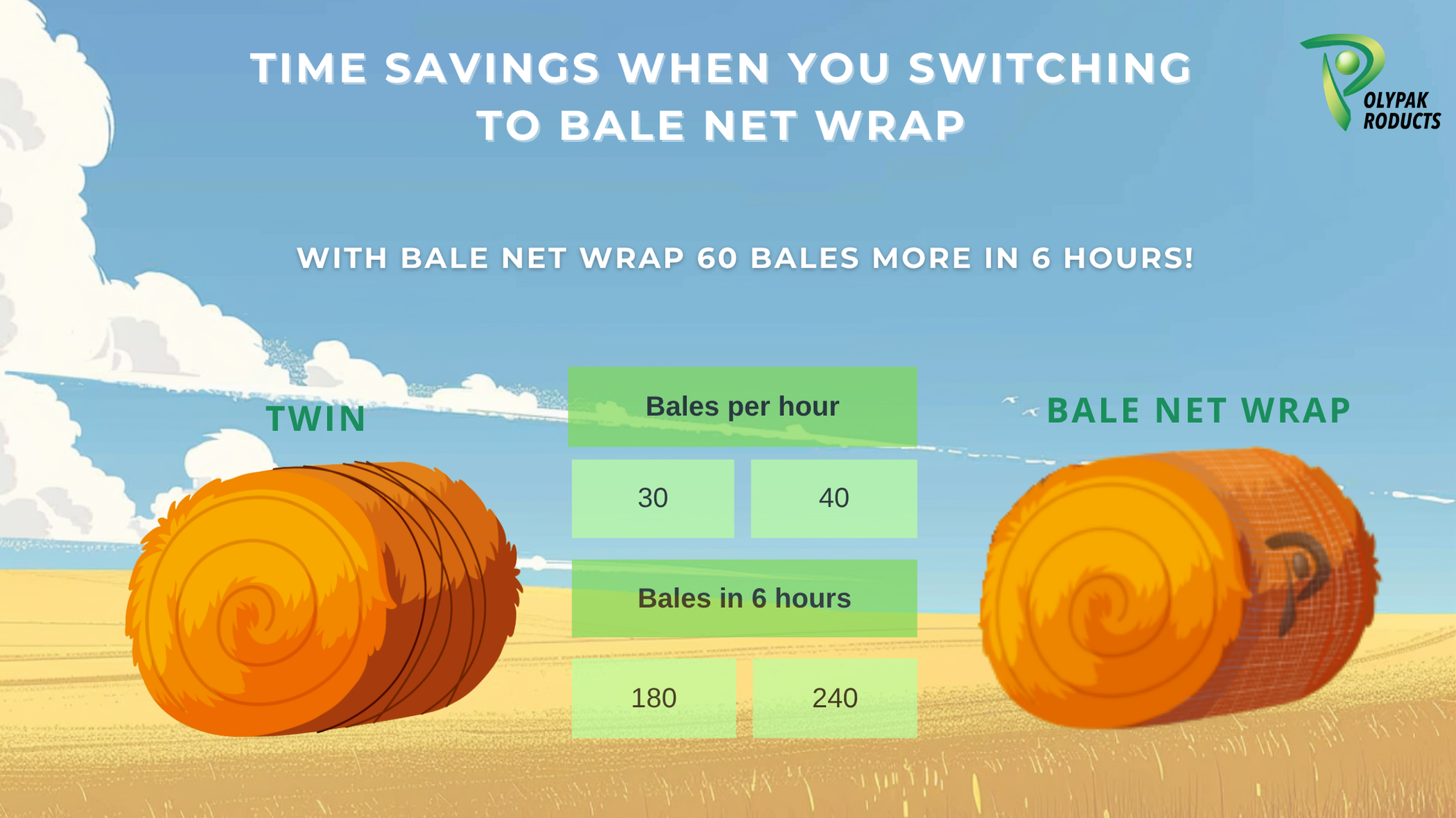
Under standard conditions, a baling cycle with net wrap takes 2–3 times less time than when using twine.

This means that within a single working day, the same machinery can produce more bales without increasing the workload on the operator or tractor.

These figures may vary depending on the baler model and field conditions, but the trend remains consistent — net wrap accelerates the process and increases overall machinery efficiency.

Fewer downtimes and material replacements

Bale net wrap comes in significantly longer rolls (on average from 2,000 to 3,600 meters), which reduces the frequency of replacements.

This minimizes equipment stops and ensures a continuous workflow.

In addition, the net-wrapping mechanism is simpler to maintain and less prone to tangling or breakage, which further decreases downtime and improves equipment reliability.

Reduced machinery load and fuel consumption

A faster wrapping cycle means less operating time for both the baler and the tractor for the same output volume.

As a result, fuel consumption decreases, component wear is reduced, and the overall service life of the machinery is extended.

For farmers, this translates into fewer repair interruptions and more economical use of their equipment fleet.

Improved bale quality

Using net wrap helps produce dense, well-shaped bales with stable geometry.

Key advantages include:

  • high density and compactness of the bale;
  • no material loss during transport;
  • surface protection against chafing and moisture;
  • easier stacking during storage.

Such bales retain their shape even after long-term storage and are easier to transport — a particularly important factor for forage preparation and sales.

Economic effect

Although specific figures depend on regional conditions and operating environments, the benefits of switching to net wrap are clearly expressed in the following results:

  • increased machine productivity by 200–300 %;
  • reduced downtime and maintenance costs;
  • lower fuel consumption and reduced component wear;
  • decreased losses during storage and transportation.

Even with a slightly higher cost per roll, the total cost per bale becomes lower due to time and resource savings.

Practical recommendations for choosing polypak net wrap

When selecting a bale net wrap, it is important to consider your equipment specifications and operating conditions.

Polypak offers professional bale wrapping solutions developed with the needs of European farmers and forage producers in mind.

You can explore all available types of our net wrap in the Catalogue.

Using Polypak net bale wrap ensures reliable and stable baler operation, minimizes downtime, and delivers perfectly formed bales under any working conditions.

Conclusion

Net wrap is an effective solution for increasing productivity and optimizing the performance of baling machinery.

It reduces wrapping time, decreases equipment load, improves bale quality, and helps utilize resources more efficiently.

Polypak manufactures durable and reliable net wraps that have been tested and proven in real European farming conditions.

Contact our specialists to select the optimal Polypak net wrap for your baler type or to place an order.