How to storepallet netting in a warehouse to extend its service life

Pallet nettig is a high-tech material made from high-strength polyethylene (PE) or polypropylene (PP) filaments. Its primary function is the secure stabilization and protection of goods on pallets during transportation and storage. However, its performance characteristics can be significantly compromised even before use – during the warehouse storage stage. Exposure to ultraviolet light, temperature fluctuations, improper placement, and mechanical damage lead to polymer degradation, reduced tensile strength, and an increased percentage of defective material.

1. Key enemies of pallet netting in the warehouse: a scientific approach

The resistance of polymer materials to external factors is not limitless. The main threats can be systematized as follows:

    • Ultraviolet  radiation: Sunlight is the primary destructive factor. UV rays initiate the process of photo-oxidative degradation, leading to the breaking of polymer molecular chains. Visually, this manifests as yellowing, loss of elasticity, and increased brittleness of the netting.
  • Research shows that constant exposure to direct sunlight can reduce polyethylene strength by 50% in just a few months.
    • Temperature regime: Polymers are sensitive to extreme temperatures.
    • High temperatures (> +35°C): Accelerate the aging process and can lead to deformation of the rolls.
    • Low temperatures (< 0°C): Make the material more rigid and brittle, increasing the risk of microcracks during unwinding.
  • Moisture and chemical agents: Although the netting is inert to many substances, prolonged contact with moisture or aggressive chemicals (acids, alkalis, solvents) can lead to surface degradation and reduced strength.
  • Mechanical damage: Improper handling (throwing rolls, dropping) leads to deformation, tearing, and contamination of the material.

2. Principles of proper storage: a step-by-step guide

Adhering to these principles will preserve the original properties of the netting throughout its storage life.

2.1. Selection and preparation of the warehouse premises

  • Enclosed and dry premises: Netting should be stored in an enclosed warehouse with a controlled microclimate.
  • Protection from UV-Radiation: Windows should be tinted or covered with curtains. Artificial lighting is preferable with lamps that do not emit UV spectrum.
  • Temperature control: The recommended temperature range is from +5°C to +25°C. Storage in immediate proximity to heating appliances is not permitted.
  • Ventilation: The premises must be well-ventilated to prevent condensation and odors.

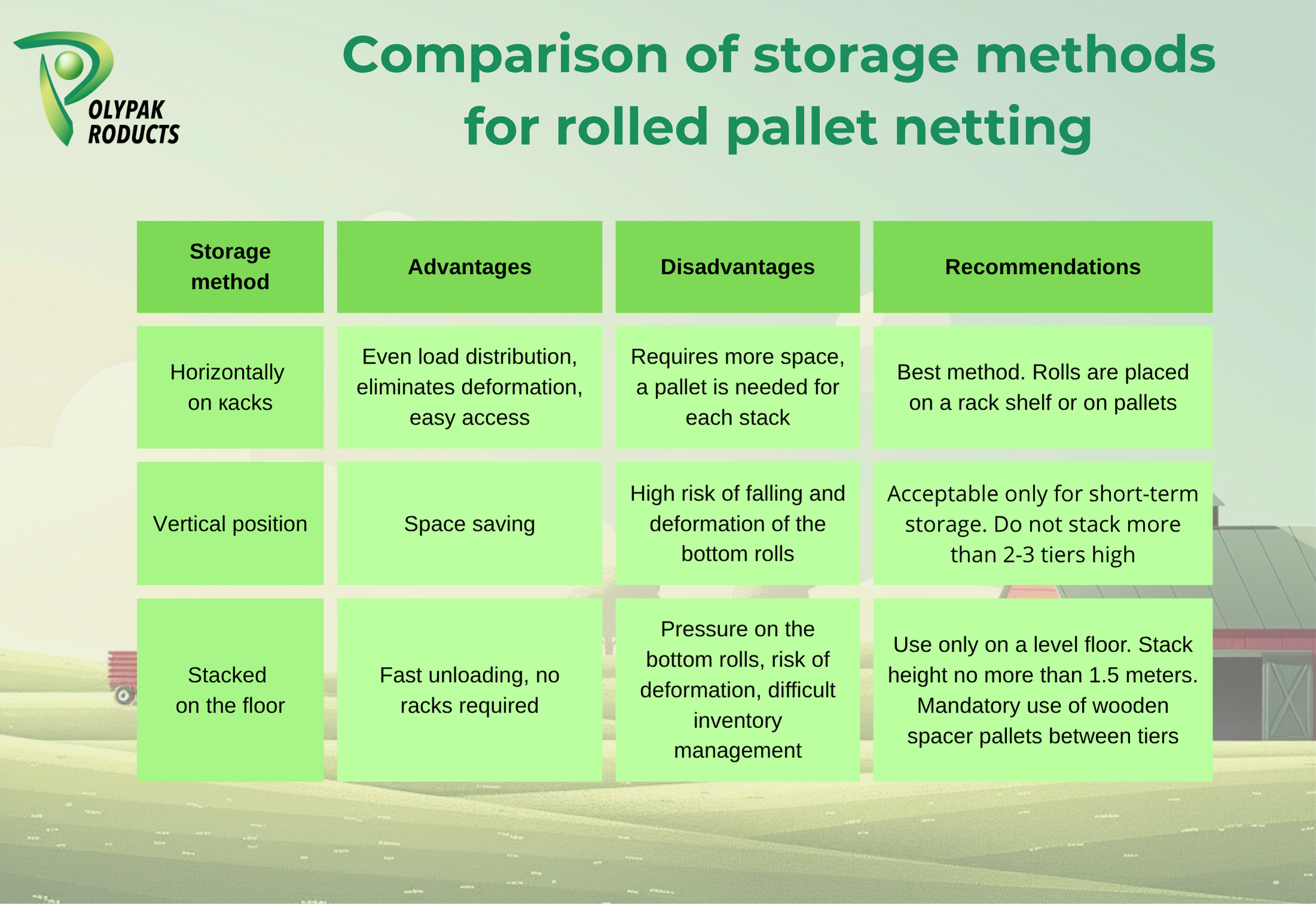
2.2. Organization of the storage system

A racking system is recommended for efficient storage and damage minimization.

3. Compliance with rules for storage of compatible goods

  • Do not store netting near chemically active substances, paints, oils, and products with strong odors.
  • Avoid proximity to equipment that creates vibration.

2.4. Adherence to the fifo principle (“first-in, first-out”)

Clear batch labeling and warehouse organization according to the FIFO principle prevent the accumulation of old netting and its natural degradation over time.

Conclusion

Pallet netting is a reliable and economical product, whose potential is fully realized only when the rules of operation are followed, starting from the warehouse. Organizing proper storage conditions is not an additional cost item, but a strategic investment in the continuity of your logistics processes, cargo safety, and overall business efficiency. An approach based on understanding the properties of polymer materials and following these simple recommendations guarantees that every roll of netting will deliver its full performance potential. Please contact us if you have any questions.